
 Get Android
How Can I Improve My English Accent? 10 English Accent Exercises for Better Pronunciation
Wondering how to speak clearer English? Here are the top ten practice exercises for long-term improvement, plus how Syranto makes the most of these exercise types.
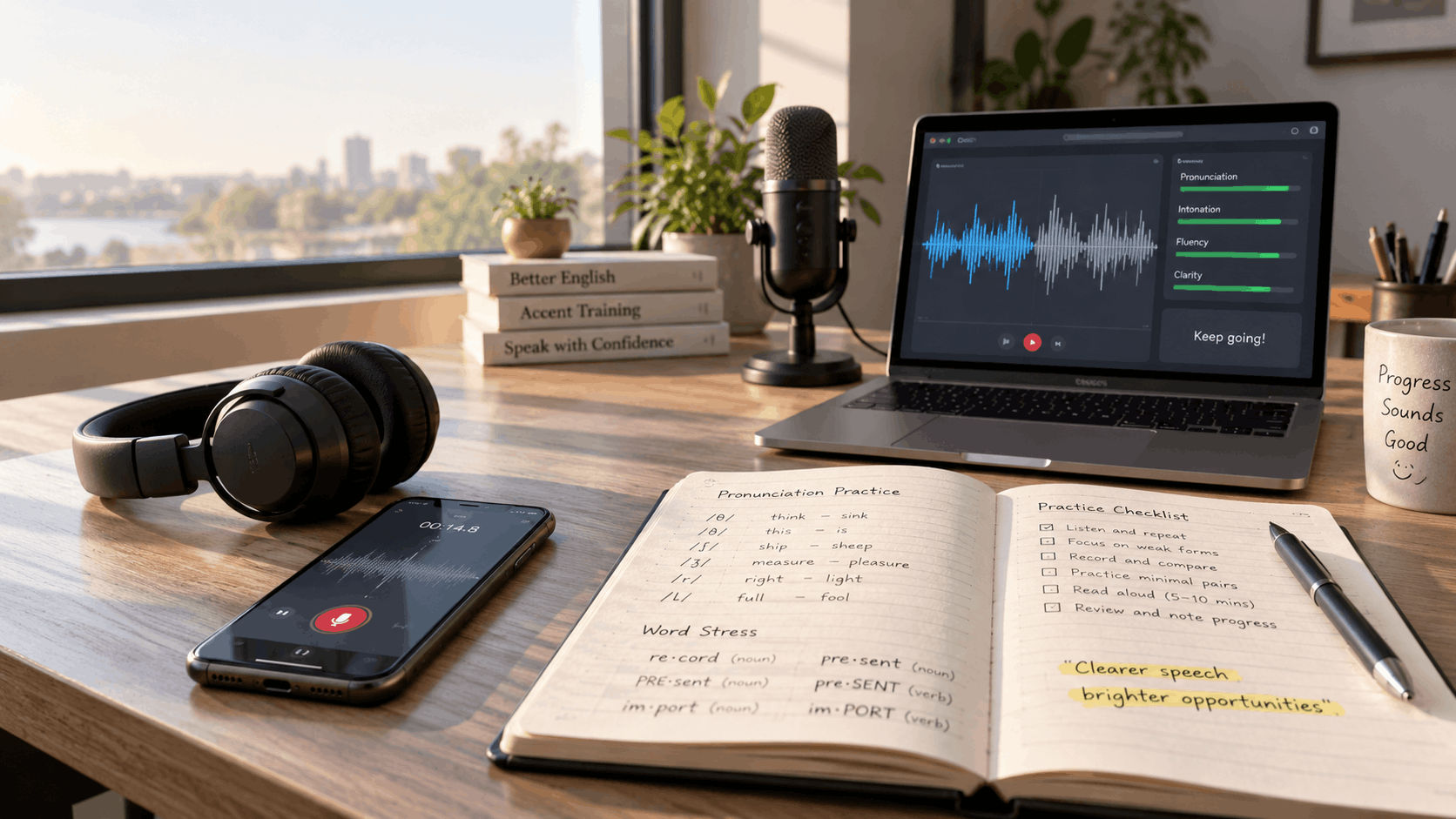
You already know that long-term practice is the key to a clearer and more native-like English accent. But what does that practice actually look like? It’s not enough to just “practice your accent” without a clear plan moving forward.
Here, we’ll explore ten different accent training exercises that target specific parts of the improvement process. We’ll see how each exercise type fits into the larger model of listening, speaking, getting feedback, applying that feedback, and growing!
How Can I Improve My English Accent?
Improving your English accent requires more than repeating individual words. Effective practice trains you to hear important sound differences, produce them accurately, use them inside sentences, and maintain clear pronunciation during longer and faster speech. Exercises such as listening discrimination, minimal pairs, shadowing, sentence recording, timed reading, and story reading can train these skills at different stages.
Which English Accent Exercises Should I Use?
English Accent Exercise Type | What it Trains | What It’s Best For | Example of Practice |
|---|---|---|---|
Listening Discrimination | Hearing a target sound accurately | Learners who struggle to hear differences between similar sounds | Listen to several similar words and identify the word containing the target sound |
Odd One Out | Recognizing a sound among similar alternatives | Training careful listening to a sound in a specific word position | Hear light, right, white, night and identify the word beginning with /l/ |
Sentence Discrimination | Hearing sound contrasts in context | Learners who can hear differences in single words but struggle in sentences | Listen to “The cat will sit/sat on the rug” and identify the word used |
Minimal Pairs | Separating two similar sounds in perception and production | Common sound confusions such as /r/ vs. /l/ or /p/ vs. /b/ | Record contrasting word pairs and make each sound clearly different |
Rapid Alternation Drills | Switching quickly between similar articulation patterns | Building faster control of easily confused sounds | Repeat pat, bat, pat, bat while keeping /p/ voiceless and /b/ voiced |
Speak & Fill | Producing a target sound inside meaningful vocabulary | Moving from recognition into controlled spoken production | Choose the correct word to complete a sentence, then say it aloud |
Shadowing | Pronunciation, stress, rhythm, and timing | Matching the patterns of natural spoken English | Hear part of a sentence and produce the target word with matching pronunciation and timing |
Sentence Recording | Accurate pronunciation in complete sentences | Moving a target sound from word practice into connected speech | Record a full sentence and receive feedback on the target pronunciation |
Timed Reading | Pronunciation accuracy at faster speaking speeds | Learners whose pronunciation becomes less clear when they speak faster | Read a sound-rich sentence smoothly and quickly while maintaining articulation |
Story Reading | Pronunciation across longer connected speech | Combining sounds, rhythm, timing, and fluency | Read a short story containing many examples of the target sound |
What Are English Accent Exercises Actually Training?
Your English accent is made up of several different features that are constantly interacting. The way that you hear English versus your native language, the ways that your mouth and tongue are already conditioned to speak, and the way you use rhythm and stress to keep your speech flowing all contribute to your English accent.
Comprehensive accent training touches on all of these elements: listening, phoneme-level pronunciation, linking, and fluency. It happens in stages, and the growth process relies on the same steps that you take when you’re hearing and producing English.
Step 1: Hear the Difference
Good pronunciation starts with accurate listening. You need to recognize the target sound before you can monitor it in your own speech, so exercises like Listening Discrimination, Odd One Out, and Sentence Discrimination train your ear to notice important sound differences.
Step 2: Contrast Similar Sounds
Some English sounds are easy to confuse because they are produced in similar ways or do not exist as separate sounds in your first language. Minimal Pairs and Rapid Alternation Drills help you separate these sounds clearly and switch between them with greater control.
Step 3: Produce the Sounds Deliberately
Once you can hear the difference, the next step is accurate production. Speak & Fill and Minimal Pairs Recording give you focused practice with the target sound, so you can pay close attention to articulation, voicing, and other pronunciation details.
Step 4: Integrate the Sounds Into Longer Speech
A sound also needs to stay accurate inside complete sentences. Shadowing and Sentence Recording help you use the pronunciation target while managing natural stress, rhythm, timing, and the surrounding sounds of connected English.
Step 5: Automate Your Pronunciation for a Clearer Accent
The final goal is to keep your pronunciation clear without consciously thinking about every mouth movement. Timed Reading and Story Reading add speed, longer sentences, and more language to process, which helps accurate pronunciation become more automatic.
Hear → Contrast → Produce → Integrate → Automate
Which English Accent Exercise Should I Start With?
You need to choose the right accent practice according to your goals and your weak spots. First, identify the step in the training process that needs the most support. Then, use this table to pick the exercise(s) that will best help you improve that step.
If your main problem is… | Start with… | Progress to… |
|---|---|---|
You cannot hear two similar English sounds clearly | Listening Discrimination | Minimal Pairs |
You frequently confuse two sounds when speaking | Minimal Pairs | Rapid Alternation |
You pronounce a sound correctly alone but lose it in sentences | Speak & Fill | Sentence Recording |
Your stress or rhythm sounds different from the model | Shadowing | Story Reading |
Your pronunciation becomes unclear when you speak faster | Timed Reading | Story Reading |
You have trouble judging your own pronunciation | Recording with feedback | Repeat the targeted exercise after feedback |
You don’t need to practice each exercise equally; you should be focusing your time and effort on the particular weaknesses that you’re trying to improve.
10 English Accent Exercises for Better Pronunciation
Different English accent exercises train different parts of pronunciation. Some sharpen your ability to hear English sounds, while others build articulation, connected speech, or pronunciation control under greater speaking pressure. Research supports this progression: phonetic perception training can improve L2 sound perception and can also transfer to speech production, although transfer becomes harder with new words and more complex speaking tasks.
1. Listening Discrimination: Train Your Ear First
Listening discrimination exercises train you to recognize a target English sound among similar sounds. You might hear several words and choose the one containing /l/, /r/, /ɪ/, or /iː/. This focused English pronunciation listening practice builds the sound categories you need for later speaking practice.
Research strongly supports perceptual phonetic training. A recent meta-analysis of 79 studies found medium-to-large improvements in L2 speech perception, while another meta-analysis found that perception training can also produce smaller gains in pronunciation.
2. Odd One Out: Find the Target Sound
An Odd One Out pronunciation exercise makes listening more precise. You hear similar words such as light, right, white, and night, then identify the word that begins with /l/. Similar answer choices force you to focus on the exact acoustic information that separates one English sound from another.
This type of accent listening exercise fits closely with identification tasks used in phonetic training research. Studies show that targeted perceptual practice can help learners direct attention toward the acoustic cues that distinguish difficult L2 sound contrasts.
3. Sentence Discrimination: Hear Pronunciation in Context
A sound that seems clear in a single word can become harder to identify inside natural speech. Sentence discrimination exercises place pronunciation contrasts into complete sentences, such as “The cat will sit/sat on the rug,” so you practice hearing English sounds alongside surrounding words.
This makes English pronunciation listening practice more contextual. Research on phonetic training shows that learning can generalize to new words and phonetic contexts, although generalization is usually weaker than improvement on familiar training items.
4. Minimal Pairs: Practice Similar English Sounds
Minimal pair exercises focus on words that differ by one sound, such as ship/sheep, light/right, or pat/bat. They are especially useful for English accent training when two phonemes are difficult to hear or produce as clearly separate sounds.
Minimal-pair practice can combine listening with English pronunciation practice, so you first identify the contrast and then record both words. Research using minimal-pair word lists for the English /i/–/ɪ/ contrast found significant improvements in sound identification after phonetic training, including transfer to new speakers and contexts.
5. Rapid Alternation Drills: Build Faster Sound Control
Once you can produce two sounds separately, rapid pronunciation drills make you switch between them: pat, bat, pat, bat or pack, back, pack, back. The goal is clear articulation at increasing speed while preserving differences such as voicing or tongue position.
These accent training exercises increase the processing demands of pronunciation practice. In fact, research on second-language pronunciation shows that greater task complexity can reduce the accuracy of some English consonants and can affect how comprehensible speech sounds. Controlled drills give you a bridge between slow pronunciation and more demanding speech.
6. Speak & Fill: Practice Pronunciation in Meaningful Words
Speak & Fill exercises combine language processing with controlled pronunciation. You listen to a sentence, select the correct word from similar options, and say that word aloud. For example, “He put the books in the _____” might include back, bag, bake, and bug.
This type of English pronunciation exercise keeps attention on one target sound while placing it inside meaningful language. Research on phonetic training also suggests that explicit information about target sounds can strengthen production gains, which supports focused accent practice where learners know exactly what pronunciation feature they are training.
7. Shadowing: Match English Pronunciation, Stress, and Timing
Shadowing exercises for English pronunciation ask you to listen closely to a model and reproduce its speech pattern. Syranto's Shadow Drill pauses before a target word, giving you space to produce that word while matching the speaker's pronunciation, stress, speed, and timing.
A 2025 systematic review covering 44 shadowing studies found evidence that shadowing can improve L2 comprehensibility, intelligibility, fluency, accentedness, and aspects of prosody such as rhythm and intonation. Evidence for improvement in individual phonemes was less conclusive, which makes shadowing especially relevant for broader accent and connected-speech practice.
8. Sentence Recording: Move From Words to Connected Speech
Sentence recording exercises move your pronunciation target into complete speech. After practicing a word through Speak & Fill or Shadowing, you record the full sentence and receive feedback on how accurately the target sound survives alongside stress, rhythm, and surrounding words.
Feedback can make this English accent practice more targeted. A meta-analysis of automatic speech recognition research found a medium overall effect on ESL/EFL pronunciation, with larger effects for systems that provided explicit corrective feedback. Separate English pronunciation research has also found individualized corrective feedback more effective than listening-only practice for short-term gains in comprehensibility.
9. Timed Reading: Keep Your Pronunciation Clear at Speed
Timed reading exercises increase the pressure on your pronunciation. You read target-rich sentences smoothly and at a natural pace while trying to keep individual sounds clear. This tests whether careful pronunciation remains stable as speaking speed and processing demands increase.
That progression matters for English pronunciation and fluency practice. Research on L2 task complexity found that added speaking demands reduced the accuracy of some consonants and lowered ratings of comprehensibility and accentedness. Research on timed and repeated L2 reading also shows that repeated fluency practice can increase reading rate over time.
10. Story Reading: Practice Pronunciation in Longer Speech
Reading aloud for pronunciation gives you more language to manage at once. A Story Reading exercise uses a short passage with a high frequency of the target sound, so you practice pronunciation across multiple sentences while also controlling rhythm, phrasing, timing, and intonation.
This makes story reading a useful final stage of English accent practice. Research on reading aloud with input and feedback shows that pronunciation can become less accurate as speaking tasks demand more attention, while shadowing research suggests that extended imitation practice can support fluency and prosodic control. Story reading brings those demands together in longer, connected English speech.
How to Build an English Accent Practice Routine
A good English accent practice routine follows a clear order: listen first, practice the sound carefully, move into sentences, then add speed and longer speech. This makes your English pronunciation practice more focused and helps you spend time on the skills that need the most work.
Start with listening discrimination if the sound is hard to hear. Then use minimal pairs, pronunciation drills, or Speak & Fill exercises to practice controlled production. Once the sound feels more stable, move into shadowing and sentence recording to practice stress, rhythm, timing, and connected speech.
Finish with timed reading or story reading so you can maintain clear pronunciation with more language to process. Use pronunciation feedback after each stage, adjust the target sound, and repeat the exercise. This hear → produce → integrate → automate sequence gives you a practical way to improve your English accent step by step.
How Syranto Uses English Accent Exercises
Syranto combines different English accent exercises because pronunciation practice involves several skills at once. You may need to hear a sound clearly, produce the contrast accurately, use it in a sentence, and keep it stable during longer speech.
The exercises support targeted pronunciation practice for specific English sounds and speech features. Listening tasks build sound awareness, minimal pairs sharpen contrasts, shadowing develops rhythm and timing, and sentence recording moves pronunciation into connected speech.
Syranto also gives immediate pronunciation feedback on spoken exercises. This helps you identify which sounds or features need more work and repeat the right accent training exercises with a clearer target.
As your pronunciation becomes more controlled, you can move from short sound-focused activities toward sentences, timed reading, and story-based English pronunciation practice. Choose one pronunciation target and start with the Syranto exercise that matches the skill you want to improve.
Improve Your English Accent One Skill at a Time
Different accent problems need different English accent exercises. The most useful approach is to hear the target clearly, contrast it with similar sounds, produce it accurately, use it in sentences, and maintain it during longer speech.
Choose one pronunciation feature you want to improve, match it with the right English pronunciation exercise, and build your practice from controlled production toward connected speech. Syranto gives you targeted accent practice and feedback throughout that progression.
FAQs About Improving Your English Accent
What exercises can improve my English accent?
Useful English accent exercises include listening discrimination, minimal pairs, shadowing, sentence recording, timed reading, and reading aloud. The best pronunciation exercises depend on whether you need to improve sound perception, articulation, rhythm, connected speech, or pronunciation at a natural speaking speed.
Should I practice listening or speaking first?
Start with listening practice when you struggle to hear the difference between two English sounds. Once you can recognize the contrast, move into speaking exercises such as minimal pairs, sentence recording, and other English pronunciation exercises that train accurate production.
Are minimal pairs good for accent training?
Yes. Minimal pair exercises help you practice two words that differ by one sound, such as ship and sheep or light and right. They are especially useful for accent training when two English phonemes sound similar or feel difficult to produce separately.
Does shadowing improve English pronunciation?
Shadowing exercises train you to match a model speaker's pronunciation, stress, rhythm, and timing. Shadowing can be especially useful for learners who want to improve English pronunciation, connected speech, and the overall rhythm of their spoken English.
Does reading aloud improve pronunciation?
Reading aloud gives you longer English pronunciation practice while you manage sounds, stress, rhythm, timing, and phrasing together. Timed reading and story reading can help you keep clear pronunciation as sentences become longer and your speaking pace becomes more natural.
Can I improve my English accent by myself?
You can make progress with a structured English accent practice routine that includes listening models, pronunciation drills, recordings, and feedback. Focus on one target at a time and use exercises that move from careful sound practice into complete sentences and connected speech.
How often should I practice my English accent?
Short, focused accent practice works well when you repeat it consistently. A daily pronunciation routine can include a few minutes of listening, targeted sound practice, sentence recording, and feedback. Consistent practice helps accurate pronunciation become easier to use in everyday speech.
Let Syranto be your guide. The app listens to your accent, helps you define the areas that need the most work, and creates a lesson path with scientifically-backed exercises to target your weak spots.
Shape your accent, we guide the way.
Reading helps you understand. Practice helps you change how you sound.
Start practicing →