
 Get Android
Listening Discrimination Exercises for Clearer English Pronunciation
Here's everything you need to know about listening discrimination exercises: what they are, why they work, and how to use them in your English accent practice.

Good pronunciation starts with good listening. If two English sounds seem almost identical, your mouth has a harder job producing them as clearly different sounds.
Listening discrimination exercises train you to hear a target phoneme among similar-sounding words or phrases. This focused English pronunciation listening practice strengthens the sound categories you need for clearer speech.
Quick Answer: What Is a Listening Discrimination Exercise?
A listening discrimination exercise asks you to hear an audio clip and choose the word that contains a specific target sound. The answer choices sound similar, so you have to listen closely to consonants, vowels, or sound position. This type of English sound discrimination practice develops phoneme recognition before you move into pronunciation production. You need this specific step to make the most of your English accent training exercises.
Why Listening Matters for English Pronunciation
Your first language shapes the way you sort speech sounds. English may separate two phonemes that your existing sound system places very close together.
Focused pronunciation listening exercises give your brain repeated practice with that distinction.
A 2025 meta-analysis of 79 high-variability phonetic training studies found medium-to-large improvements in second-language speech perception. The researchers also found evidence that learners retained many perception gains and could apply some learning to unfamiliar speech examples.
That makes English listening practice for pronunciation an important first step when a sound contrast is difficult to hear.
How Listening Discrimination Practice Works
Syranto's Listening Discrimination exercises play a word or short phrase and give you several similar options.
Your task is simple; here’s an example:
Listen to the audio. Identify the word that starts with the /r/ sound.
[The correct answer is “C. Right.”]
The similar answer choices keep your attention on pronunciation. You need to listen for the exact sound instead of relying on meaning or an obvious difference between the words.
Identification Builds More Precise Listening
This type of phoneme identification exercise is well represented in pronunciation research.
A 2024 study trained Catalan/Spanish bilingual learners of English with identification and discrimination tasks. Both training methods improved learners' ability to identify and discriminate English vowels. The gains also transferred to new words and remained measurable four months later.
That is the goal of English sound identification practice. You want to recognize the target phoneme across many words, rather than memorize one small practice list.
Similar-Sounding Options Make You Listen More Carefully
If the answer choices sound completely different, the exercise becomes easy for the wrong reason.
Strong listening discrimination practice uses closely related options.
The large 2025 meta-analysis found that training design matters. Factors such as the type of task, target phonemes, response options, training time, and number of speakers all influenced perceptual learning outcomes.
So a good English pronunciation listening exercise needs a clear sound target and carefully chosen alternatives.
Hearing the Sound Can Support Better Production
Listening practice mainly trains perception, but the benefits can also reach pronunciation.
A meta-analysis of 25 years of L2 perception training found medium improvements in speech perception and smaller positive improvements in speech production.
A newer 2024 meta-analysis reached a similar conclusion. Perception-based phonetic training produced small-to-medium gains in L2 speech production, especially for sounds and words learners had directly practiced, and even when they were practicing English alone.
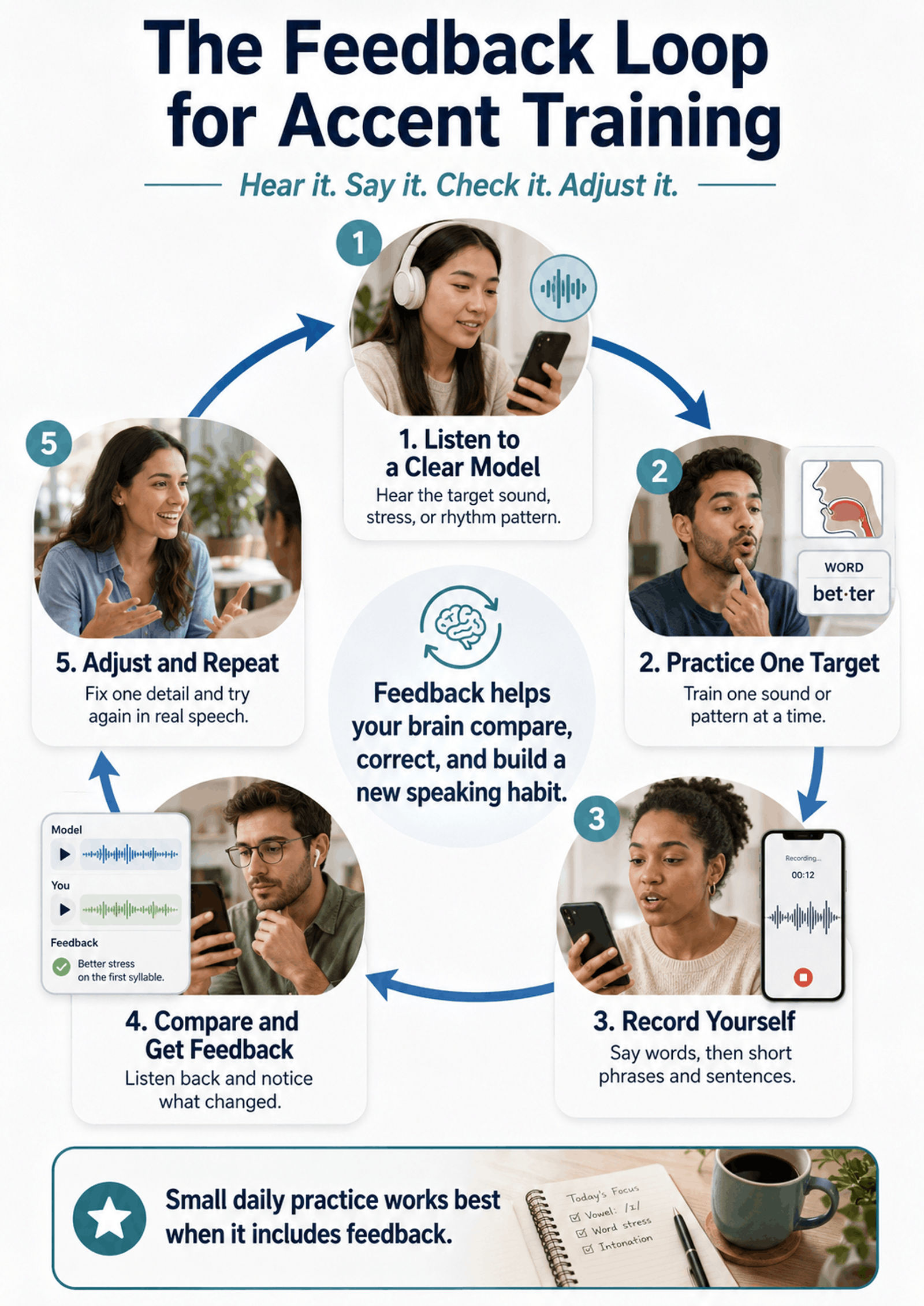
This is why listening discrimination exercises work well at the beginning of an accent practice sequence. First you learn to hear the target. Then you practice producing it.
Listening Discrimination and Minimal Pairs Work Well Together
Listening discrimination answers one question:
Can you hear which sound is present?
Minimal pair practice takes the next step:
Can you keep two similar sounds clearly separate?
For example, listening discrimination can help you identify whether you heard ship or sheep. A minimal pair recording exercise then asks you to pronounce both words clearly.
Together, these English pronunciation exercises connect perception with production.
How to Practice English Sound Discrimination
Choose one pronunciation target at a time.
Listen to the audio before looking too closely at the answer choices. Focus on the specific sound and its position in the word.
Select the answer, check your result, then listen again when possible. As your phoneme discrimination skills improve, practice the same contrast across new vocabulary and different speakers.
Then move into spoken exercises so the sound you can hear becomes a sound you can produce accurately.
Where Listening Discrimination Fits Into Accent Training
Listening Discrimination belongs in the Hear stage of accent training:
Hear → Contrast → Produce → Integrate → Automate
These English listening pronunciation exercises help you recognize the target sound first.
Minimal pairs can then strengthen the contrast. Speak & Fill, sentence recording, shadowing, and timed reading move that sound into increasingly natural English speech.
How Syranto Uses Listening Discrimination Exercises
Syranto uses Listening Discrimination exercises to train precise sound recognition.
You hear an audio clip, then choose the word that contains the lesson's target phoneme in the specified position. Similar-sounding answer choices make careful listening essential.
This focused English sound discrimination practice helps you identify pronunciation differences before you produce them yourself in later accent exercises.
Frequently Asked Questions
What is listening discrimination in pronunciation?
Listening discrimination means hearing and identifying differences between speech sounds. In English pronunciation practice, you may listen to similar words and choose the one containing a specific consonant or vowel.
Do listening exercises improve pronunciation?
Research shows strong effects of phonetic listening training on speech perception and smaller positive effects on production. Spoken pronunciation practice should follow listening work for stronger production training.
What is phoneme discrimination?
Phoneme discrimination is the ability to hear whether speech sounds belong to different sound categories. For example, an English learner may practice hearing the difference between /ɪ/ and /iː/.
Should I practice listening before speaking?
Start with pronunciation listening practice when you struggle to hear the target contrast. Once you can identify the sounds reliably, move into minimal pairs and spoken pronunciation exercises.
How does Syranto use listening discrimination?
Syranto plays a word or phrase and asks you to identify the option containing a specific target phoneme. The exercise develops English sound recognition before you move into production-focused accent practice.
Syranto has a whole library of listening discrimination exercises to help you take the first step towards a more natural and native-like English accent.
Shape your accent, we guide the way.
Reading helps you understand. Practice helps you change how you sound.
Start practicing →