Get Android
Interactive AI Speaking Feedback: Ask a Better Follow-Up Question
When you have the chance to ask your AI tutor questions, do you know what to ask? Here's a look at the research that shows exactly how to make the most of interactive AI feedback for English pronunciation.

You record a sentence to check your pronunciation. The feedback says, “Make the consonant clearer.” You read the sentence again, but you still do not know which sound needs attention.
You could ask: “Which word was unclear? What did you hear? Can you give me an example?”
Interactive AI speaking feedback gives you a way to continue the exchange. The important part is what you do with the answer: check the explanation, try an adjustment, and find out whether your meaning comes through.
Quick Answer: How Does Interactive AI Speaking Feedback Help My Accent?
Interactive AI speaking feedback lets you ask questions about a correction and try again within a conversation. Ask which word or feature needs attention, check the explanation against a reliable model, and test a new sentence. Use recordings and listener responses alongside automated comments. A detailed conversation with an AI system does not guarantee an accurate pronunciation assessment.
Using the Feedback for Better English Pronunciation
“Work on your English pronunciation” is a broad instruction. “Was my word clue or crew unclear?” gives you something specific to investigate.
A clue helps you solve a problem. A crew is a group of people working together. In these words, /l/ and /r/ distinguish the meanings. These symbols represent the sounds at the start of light and right.
For pronunciation practice, begin by asking what the listener heard. You might say, “The crew found a clue,” then ask someone to identify both words without seeing the sentence.
Interactive AI speaking feedback can help organize that exchange when the tool supports the relevant audio task. Check what information it actually receives and assesses. A written sentence alone does not reveal how you pronounced its sounds.
What Did the Study Compare?
Shafiee Rad’s 2026 study randomly assigned 120 intermediate Persian-speaking learners, aged 19–25, to four groups of 30.
How Did the Experiment Work?
Test speaking and feedback literacy.
Follow shared instruction for 12 weeks, with matched 90-minute sessions and feedback quantities.
Compare interactive versus one-way feedback, delivered through AI or humans.
Repeat assessments; analyze conversations and interviews.
What Were the Results?
Feedback condition | Speaking Mean Before → After |
|---|---|
Interactive AI: ChatGPT | 3.59 → 8.90 |
One-way AI: ELSA Speak | 3.70 → 5.26 |
Interactive human: Zoom | 3.60 → 6.33 |
One-way teacher: Audacity recordings | 3.74 → 3.87 |
Human raters used IELTS-based criteria on a 1–9 scale; these were not official exam results. In the interactive AI group, the average feedback literacy rating rose from 1.29 to 5.44 on a six-point questionnaire. Dialogue groups showed more clarification and checking. The author favors combining AI with interactive feedback.
What Needs Caution?
Methods and results reverse group-number labels; the table follows the results narrative. The 8.90 mean, with standard deviation 0.088, is unusually near the maximum with little variation. Individual AI conversations also differed from small-group human interaction. These issues limit causal conclusions. Read the original paper.
What Makes Feedback Interactive?
A correction can be delivered as a statement: “Change this sound.” An interactive exchange lets you ask what that means, check your understanding and make another attempt.
Here is an original teaching example. It illustrates possible questions, not an actual research transcript or a guaranteed AI response.
Your Purpose | What You Could Say |
|---|---|
Locate the difficulty | “Which word was unclear in my recording?” |
Check the meaning | “Did you hear crown or clown?” |
Understand the instruction | “Can you explain that sound difference in simpler words?” |
Test an adjustment | “I will try both words again. Tell me what you hear.” |
Try a fresh context | “Give me a new situation where I need one of those words.” |
A crown is something a monarch may wear. A clown is a performer. The words give your English pronunciation practice a clear meaning difference to check.
For accent training, you do not need a long conversation about every attempt. Use enough discussion to identify a useful action, then return to speaking.
Can You Use the Comment?
Feedback literacy means being able to understand, judge and use feedback. A practical check is whether you can explain the next step in your own words.
After receiving corrective feedback, complete this sentence: “On my next attempt, I will…”
An answer such as “speak better” leaves the task open. “Check the /l/ sound in clown, then record the sentence again” gives you an action you can observe.
You can also question a comment. If AI pronunciation feedback contradicts a reliable spoken model or a teacher’s explanation, save the recording and ask for clarification. You do not need to accept a correction simply because it sounds confident.
Our guide to noticing pronunciation differences offers another way to connect what you hear with what you practice.
Common Problems with Interactive AI Speaking Feedback
You receive an explanation but never test it
Give the explanation a test during pronunciation practice. Record the same line twice, changing only the sound you discussed.
For English pronunciation, write down the target word and the feature you changed. Keep the earlier recording so you can compare actual attempts.
The system comments on information it did not hear
Before trusting AI pronunciation feedback, check whether the tool analyzed audio, a transcript or only the text you typed. Those inputs support different judgments.
If you provide only written text, ask for model pronunciation guidance or practice ideas. Do not treat comments about your actual vowel quality, consonants or rhythm as established observations of your speech.
Every correction interrupts your message
Choose when to pause for feedback. You might finish a short explanation first, then discuss one difficult phrase.
For speaking fluency practice, keep a separate attempt where you complete your message without stopping to inspect every word. You can review the recording afterward. Our self-monitoring and feedback guide can help you plan these checks.
How to Practice: Ask, Clarify, Try and Check
This original routine is a teaching suggestion. It does not reproduce the study’s prompts or establish an optimal practice schedule. You can adapt the questions for a teacher, partner or suitable audio-feedback tool.
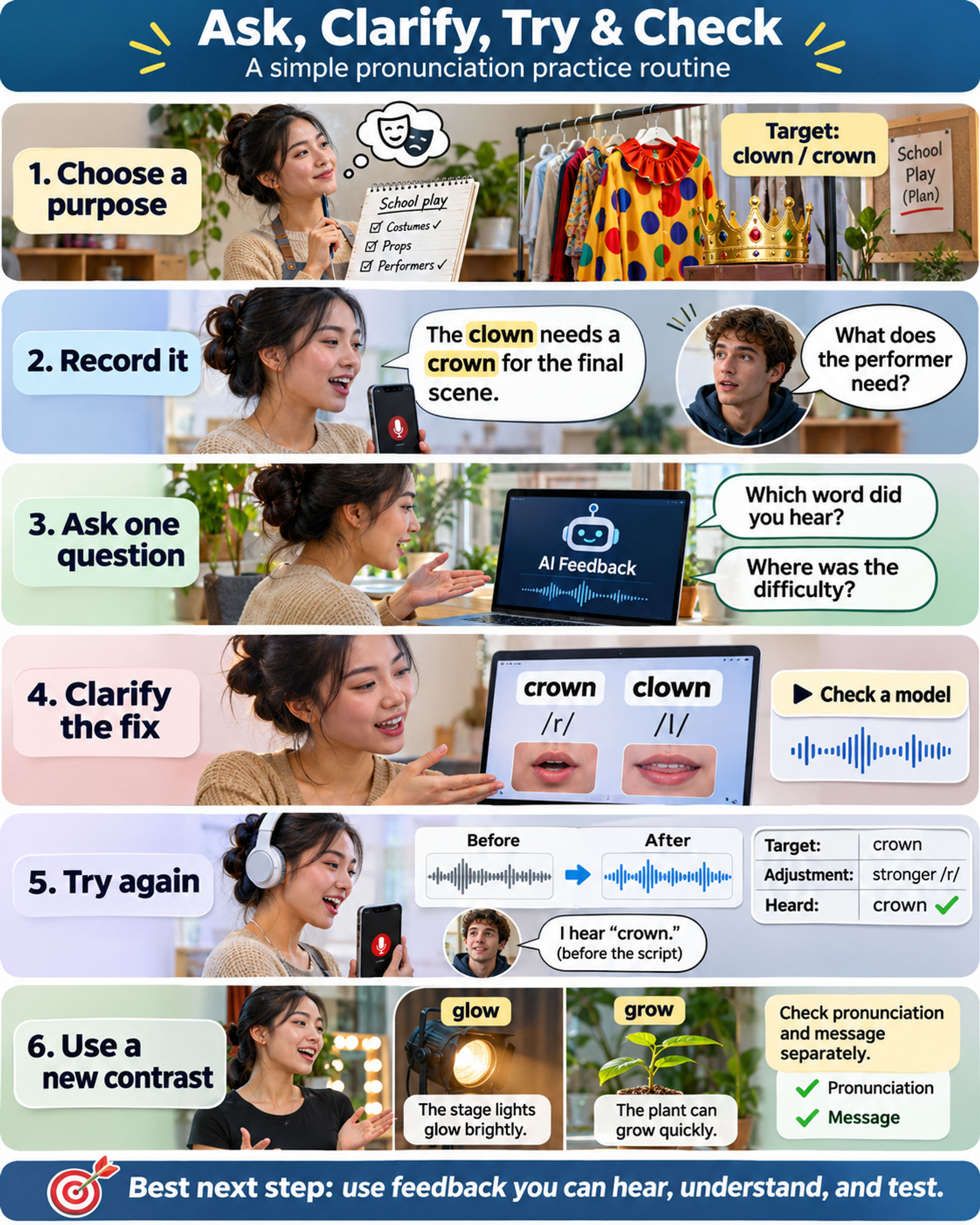
1. Choose a situation with a clear purpose
You’re organizing costumes for a school play. Explain which items the performers need and who will bring them.
Choose one accent training target before you begin. For example, you might investigate whether a listener can distinguish crown from clown. Keep the rest of your message natural.
2. Record your first attempt
Speak without reading a complete script. Save the recording, then note the message you wanted to communicate.
Try this line in your English pronunciation practice:
The clown needs a crown for the final scene.
Ask a listener what the performer needs. This checks the meaning of your message as well as the target words. Use our sentence recording exercise to organize your recordings.
3. Ask one specific follow-up question
With interactive AI speaking feedback, begin with the point you cannot interpret. Ask, “Which word did you hear?” or “Can you show me where the difficulty occurred?”
If the answer remains vague, ask for a simpler explanation. Avoid adding several unrelated questions before you have tested the first suggestion.
4. Explain the adjustment back
State what you think the correction means. For example: “I will compare the sounds right after /k/ in crown and clown, then try the sentence again.”
Check a reliable spoken model. If the sound difference is still unclear, ask a teacher to demonstrate it. This gives your English pronunciation work a reference you can return to.
5. Make a new attempt and compare
Record the sentence again. Ask your listener to identify the words before showing the script. Compare that response with any AI pronunciation feedback you received.
In your accent training notes, record the target, your adjustment and the word your listener heard. If the listener still hears a different word, return to the explanation rather than assuming that another identical repetition will resolve the problem.
6. Use the contrast in a fresh context
Try glow and grow. A stage lamp may glow: give out light. A plant may grow: become larger. The /l/ and /r/ contrast appears again, after a different starting consonant.
Start this round of pronunciation practice by listening to a model of each word. Then use each in an original sentence and ask a partner what they heard.
For speaking fluency, finish by explaining a new stage-lighting idea without pausing to check every sound. Review pronunciation and the completeness of your message afterward as separate observations.
This routine makes interactive AI speaking feedback part of a broader pronunciation feedback loop. Your next step should follow from something you can hear, understand and test. Check out our 10-Minute Daily Practice Routine for a deeper look at how to make this a consistent part of your day!
Frequently Asked Questions
What is interactive AI speaking feedback?
It is feedback that allows a continued exchange: you can ask about a correction, check an explanation and make another attempt. Before relying on it for English pronunciation, confirm what audio information the tool actually analyzes.
Is corrective feedback useful if I cannot ask questions?
A clear comment can still give you a useful action. If you understand the target, try it and check the result. When a comment is confusing, seek an explanation from another reliable source or a teacher.
Should I use conversational AI for language learning every day?
Choose a routine you can follow and review. Give each session a clear purpose, such as practicing an explanation or investigating one sound. The activity’s usefulness depends on what you do with the feedback, so track attempts and questions rather than only time spent.
Does a fluent AI conversation prove my pronunciation improved?
No. A conversation may continue even when particular sounds remain unclear. Save recordings, try unfamiliar sentences and ask listeners what they understood. Use these observations alongside app comments when reviewing progress.
Reference
Shafiee Rad, H. (2026). Effects of dialogic and monologic AI/non-AI feedback on L2 speaking development: Exploring learner achievements, feedback literacy, and interactional moves. ReCALL, First View, 1–18. https://doi.org/10.1017/S095834402610055X
Syranto offers clear pronunciation feedback that won't leave you guessing about the next steps. Get started with your personalized learning plan today!
Shape your accent, we guide the way.
Reading helps you understand. Practice helps you change how you sound.
Start practicing →