Get Android
AI-Supported English Speaking Practice: Can You Say It Without the Script?
What does the research say about AI feedback for overall fluency? Here's a deeper look at one study with results that support long-term improvement with app-based practice.

“The label is in the seed packet.” You can read that sentence aloud. Now put the script away. A friend is holding a bag of seeds and looking for the planting instructions. Can you tell them where to look?
You might say, “Open the packet. The label’s inside.” Different words, same useful message. That second attempt gives AI-supported English speaking practice a purpose: you get to find out which parts of yesterday’s lesson you can use today.
Quick Answer: How Can I Speak More Fluently?
Give your speaking practice routine three different jobs: record a message, use feedback to improve one detail, then deliver a new message without a script. Save the AI pronunciation feedback with your first recording. Compare what a listener understood across attempts, and record how much time and help you used. That gives an app score some context.
Making the Most of the Research
A seed packet and a coat pocket are both reasonable places to leave a label. The sentences “I left it in the packet” and “I left it in the pocket” send your friend to different places. You have a practical check on your English pronunciation: where did your friend look?
That question also shows the limits of a word drill. You could pronounce packet perfectly and still forget to tell your friend what’s inside. A useful speaking practice routine gives you room to work on both the sound and the message.
What Did the Malaysian Study Test?
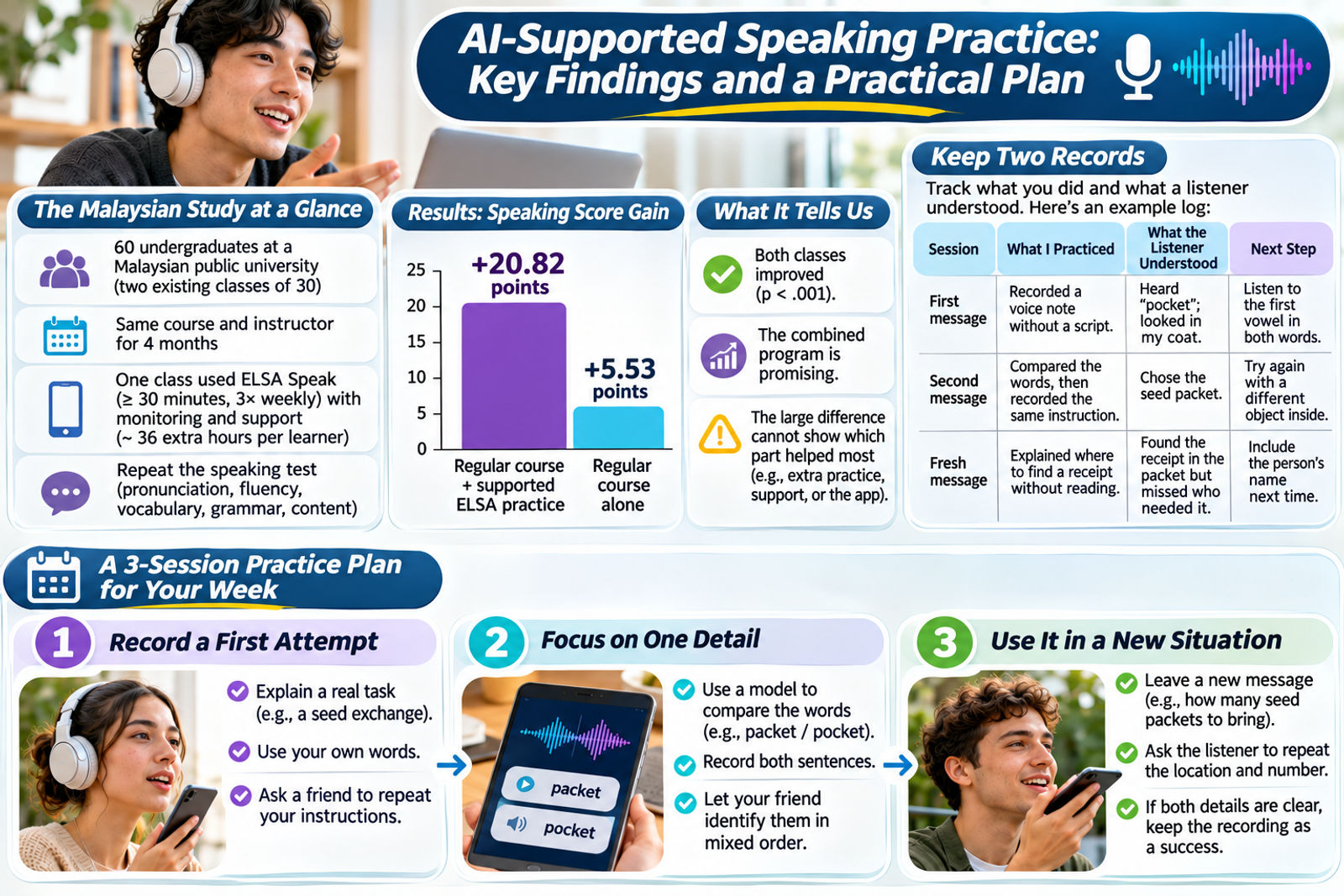
Omar Al-Jamili and colleagues followed 60 undergraduates in two existing English classes at a Malaysian public university. Each class had 30 students; individuals were not randomly assigned.
Test both classes before instruction. Give them the same course and instructor for four months.
Add ELSA Speak to one class: at least 30 minutes three times weekly, with monitoring and support. Records indicated about 36 extra hours per learner.
Repeat the speaking test. One assessor scored pronunciation, fluency, vocabulary, grammar and content. The researchers also interviewed three students and three teachers.
Class | Average Speaking Score Gain |
|---|---|
Regular course plus supported ELSA practice | 20.82 points |
Regular course alone | 5.53 points |
Both classes improved (p < .001). These are changes on the study’s scoring scale, not IELTS band gains. The authors describe the combined program as promising. The unusually large difference cannot tell us which part helped most: only one class received extra practice and support. The assessor knew the groups, and no later test checked whether gains lasted.
What Should You Track Besides Minutes?
The practical lesson for AI-supported English speaking practice is to keep two records. One describes what you did: how long you spoke, what feedback you received and whether you read a script. The other describes what you could do afterward. What information could a listener act on?
Here’s an example of a mobile-assisted language learning log you could keep in your phone. These are sample entries, not research data.
Session | What I Practiced | What the Listener Understood | Next Step |
|---|---|---|---|
First message | Recorded a voice note without a script | Heard “pocket”; looked in my coat | Listen to the first vowel in both words |
Second message | Compared the words, then recorded the same instruction | Chose the seed packet | Try again with a different object inside |
Fresh message | Explained where to find a receipt without reading | Found the receipt in the packet but missed who needed it | Include the person’s name next time |
Notice what changes in the last row. The English pronunciation target came through. More repetitions of packet would do little for the missing name. This is a good point to let accent training end for the day and work on giving a complete instruction.
How to Build AI-Supported English Speaking Practice into Your Week
Try these three sessions on days that suit you. This is an original learner exercise, separate from the research program. The schedule gives each recording a different purpose; you can adjust the time to fit your week.
Make a first recording before you rehearse. Ask a friend to help at a seed exchange. Tell them what to bring, where to find it and who needs it. Use your own words. Save the recording and ask your friend to repeat the instructions back. Note the first point where your messages differ.
Give one detail its own pronunciation practice session. If your friend heard pocket for packet, use Syranto’s Vocalize feature to hear each word in “Look in the ___.” Keep the same British or American voice for both. The first vowel changes: compare the vowel in packet with pack and the vowel in pocket with pot. Record the two sentences on your phone and let your friend identify them in mixed order.
Change the situation and put the script away. This time a volunteer needs empty seed packets for next month’s event. Leave a new voice note explaining where to find them and how many to bring. Ask the volunteer to repeat the location and number. If both details arrive clearly, keep that recording as an example of successful communication.
AI pronunciation feedback can help you choose what to rehearse in the second session. The third session answers a different question about your English speaking performance: can you use what you practiced while deciding what to say? The sentence recording exercise gives you a way to save attempts for comparison.
Common Problems with AI-Supported English Speaking Practice
Your best recording is always the fifth take. Keep the first take, too. Label recordings “first try” or “rehearsed.” When you review English pronunciation practice next week, compare first tries with first tries. Otherwise you may be comparing a sentence you know by heart with one you have never seen.
The app praises a sentence your listener misunderstood. Write down what each source tells you. Automated pronunciation feedback may identify a sound in the sentence you were asked to read. Your friend can tell you where they thought the label was. Ask which word led them there, then replay that part together. Our guide to self-monitoring and real-time feedback explains how to combine those observations.
Your sessions get longer, but the tasks never change. Set aside the final minute of pronunciation practice for a message you haven’t planned. Change one detail: the object, the person or the location. This small change gives your accent training a test outside the original exercise.
Frequently Asked Questions
How much AI-supported English speaking practice do I need?
Choose an amount you can repeat and review. Start with enough time to record a message, listen back and try one adjustment. The Malaysian study did not compare different schedules, so its practice hours cannot tell you the ideal dose for your own English pronunciation goals.
Can I use the routine without a partner every day?
Yes. Keep the first recording, save the AI pronunciation feedback, and make a fresh recording later. When someone is available, play the messages without showing the script. A listener who doesn’t know your intended answer can give you information you can’t get by reading your own notes.
How can I use model audio in mobile-assisted language learning?
Use Syranto for model audio during pronunciation practice. A separate recorder can hold your own attempts. The researchers studied ELSA Speak; the results do not establish outcomes for other apps. If you also use automated pronunciation feedback, keep its suggestions alongside your recordings so you can return to the word in context.
What should I keep from a week of accent training?
Keep one recording you rehearsed, one fresh message and a note about what your listener heard. That makes your English speaking performance easier to review than a list of scores. The pronunciation feedback loop can guide your next choice: practice the sound again, ask for a better explanation, or move on to a new message.
Reference
Al-Jamili, O., Aziz, M., Ibrahim, H., Ahmad, M., & Ba Matraf, M. S. (2026). AI-driven mobile practice and English-speaking performance: A quasi-experimental study of ELSA Speak among Malaysian university learners. Cogent Education, article 2748105.
Syranto offers real-time AI feedback, so that you can improve your English accent with research-based practice methods.
Shape your accent, we guide the way.
Reading helps you understand. Practice helps you change how you sound.
Start practicing →