Get Android
New Research in AI Pronunciation Feedback: The Tile Experiment
What does the research say about clarity and emphasis for English language learners, and how can you leverage these results for more understandable speaking and pronunciation?

Two shelves in a pottery studio hold blue tiles. The tiles on the left are dry and ready to move. The ones on the right are still wet. You send a volunteer a voice note: “Pack the blue tiles from the left shelf.” Your pronunciation app gives the recording a good score. Would you trust the volunteer to pack the right box?
Here’s a useful test for AI pronunciation feedback: keep the score, then ask someone who hasn’t read the script which tiles they would move. An app can rate how you spoke. A listener can tell you what they understood. If the answers surprise you, go back to the recording with one particular word or phrase in mind.
One recording can earn two honest answers
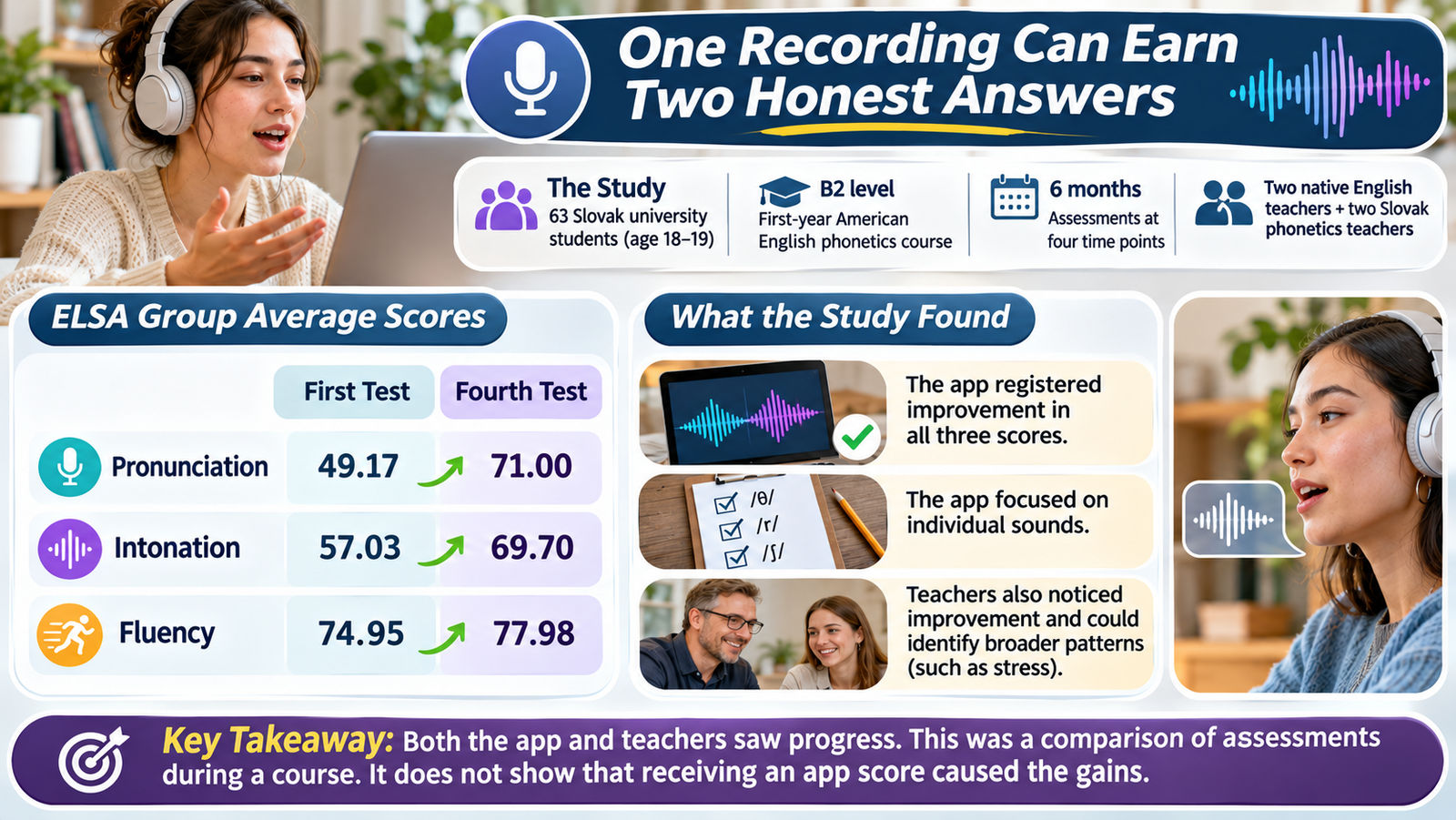
A six-month study of pronunciation assessment followed 63 Slovak university students, aged 18–19, taking a first-year course in American English phonetics. They entered at B2 level. The researchers wanted to know whether ELSA Speak and human teachers noticed the same changes in English pronunciation.
Collect speech samples at four points during the course.
Compare ELSA’s scores with judgments from four teachers: two native English speakers and two Slovak teachers of English phonetics.
Examine both overall ratings and the specific errors the evaluators identified.
ELSA Group Average | First Test | Fourth Test |
|---|---|---|
Pronunciation | 49.17 | 71.00 |
Intonation | 57.03 | 69.70 |
Fluency | 74.95 | 77.98 |
ELSA registered changes in all three scores. Its detailed error list focused on individual sounds; teachers could also describe patterns across words, such as stress. The two Slovak teachers’ average ratings also rose: from 2.06 to 3.00 and from 2.63 to 3.83 on a five-point scale. Compare the direction of change; a teacher’s 3.00 and an app’s 71.00 use different scales. This was a comparison of assessments during a course. It does not show that receiving an app score caused the gains.
Put the score aside until someone picks a shelf
Try the pottery instruction as a short English pronunciation exercise. Draw two shelves on a piece of paper. Put blue tiles on both and mark one shelf “left” and the other “right.” Keep the drawing simple enough that your partner can point to an answer.
Record “Pack the blue tiles from the left shelf.” Play it once without showing the words. Ask your partner to point to the shelf and tell you whether to take one tile or several. Write down their first answer before you explain anything.
Now look at the AI pronunciation feedback, if you have it. Say the app flagged blue, but your partner got the color right and reached for a single tile. That gives you a reason to listen closely to tiles. If the partner chose the wrong shelf instead, listen to the whole phrase from the left shelf. Those are two different jobs for pronunciation practice.
A tiny buzz can change the size of the order
Say tile, then tiles. Both words have one syllable. The plural adds /z/, the buzzing sound at the start of zip. Keep your voice going briefly as you move from the end of tile into that sound. If you hear “tile-iz” with a second beat, listen to the model again.
Give your partner a harder choice. Record “Please wrap the tile” and “Please wrap the tiles.” Both instructions make sense in the studio, and neither gives away the number with a word like one or three. Mix up the recordings and ask how many objects your partner would wrap: one or more than one?
Use Syranto’s Vocalize feature to hear the two sentences in the same voice, then record your own versions separately. A model gives your ear a reference. Your partner’s choice tells you whether the ending carried the meaning you wanted. The sentence recording guide gives you a way to keep both attempts for later.
The clearest word may be the least useful word to stress
Suppose your partner hears tiles perfectly but keeps reaching to the right. They already know the color and the object. What they need from you is the correction: “The left shelf.”
Try the same instruction in two exchanges:
What the volunteer asks | What you might say |
“Do you mean the green tiles?” | “The blue tiles from the left shelf.” |
“The blue tiles on the right?” | “The blue tiles from the left shelf.” |
The bold word marks the detail you’re correcting. Record both replies. Can a listener match each reply to its question? You now have an English pronunciation check that a list of individual sound errors cannot give you. For more examples, see how sentence stress changes meaning.
Six earlier studies, six questions to bring to the workbench
The previous articles in this series looked at different learners, tools and outcomes. Their scores do not belong in a single ranking. Each study does, however, suggest a useful question for this studio exercise. The questions below are ours; the pottery task was not part of the experiments.
Research Lens | A Question To Try With Your Recording |
|---|---|
Can you point to the moment where the word left stands out, then hear it on replay? | |
Before changing a sound, can you hear the difference you’re trying to make? | |
Which part of the report tells you what to do on your second attempt? | |
What follow-up question would help: “Which word did you hear?” or “Which shelf did you choose?” | |
Does the ending in tiles come through when your listener has no other clue about number? | |
Can you give a new instruction tomorrow without replaying today’s model? |
Tomorrow, change the order
Leave yourself a note with three details: two mugs, bottom shelf, pack them separately. Tomorrow, use those details to leave a fresh voice message. Choose your own words. Ask your partner what they would pack, where they would find it and how they would wrap it.
This last round gives your accent training a stopping point. If all three details arrive clearly, save the recording and move on. If one goes missing, you have a precise target for your next round of pronunciation practice. You can hear whether you left out the detail altogether, said a word unclearly, or put the emphasis somewhere your listener didn’t expect.
Keep the original voice note beside the new one. The next time you get AI pronunciation feedback, you’ll have something more useful than yesterday’s score for comparison: two instructions, two listener responses and a record of what you changed.
Three notes to keep beside the microphone
What if the app flags a word everyone understood? Save the comment and test the word in a less predictable sentence. If the word stays clear, give priority to a misunderstanding that affects the message. A single flag needn’t set your whole accent training plan.
What if the app gives a high score but my listener gets lost? Ask the listener to tell you the last detail they understood. Check whether the next detail was audible and whether you actually included it. Sometimes the most useful change is adding a missing direction.
Can I do the exercise alone? You can rehearse both sentences, shuffle the recordings and listen later without looking at their names. Because you already know the possible answers, save a fresh message for a listener when you can. The pronunciation feedback loop works best here when each replay helps you choose one next action.
Research reference
Longitudinal comparison of artificial intelligence-based and human evaluations of English-as-a-foreign-language pronunciation. (2026). International Journal of Computer-Assisted Language Learning and Teaching, 16(1).
Get started with Syranto, and use our library of targeted pronunciation exercises with real-time AI feedback.
Shape your accent, we guide the way.
Reading helps you understand. Practice helps you change how you sound.
Start practicing →