Get Android
Story Reading Exercises for Better English Pronunciation
Producing a target sound in one word is controlled practice. Keeping that sound clear across an entire paragraph brings pronunciation much closer to real speech. So how do we make it happen?

Story reading exercises combine target-sound practice with longer English reading aloud practice. You read a short story containing frequent examples of the target phoneme while maintaining clear pronunciation, natural rhythm, intonation, speed, and timing.
Quick Answer: What Is a Story Reading Exercise?
A story reading pronunciation exercise gives you a short passage rich in one target sound or sound contrast. You record yourself reading the story aloud while focusing on pronunciation accuracy and natural connected speech. The longer passage adds rhythm, phrasing, intonation, and fluency to focused English pronunciation practice exercises.
Why Practice Pronunciation With Longer Texts?
A sound becomes harder to monitor when you have more language to process.
Research with 82 L2 English learners found that increased speaking-task complexity reduced the accuracy of some consonants and negatively affected global measures of comprehensibility and accentedness.
That makes story reading practice a useful progression from short pronunciation drills. The text is already provided, so you can direct more attention toward your pronunciation while still managing longer stretches of connected English.
How Story Reading Practice Works
Syranto creates short stories with a high frequency of the target phoneme or minimal-pair contrast.
For example, a lesson contrasting /æ/ and /e/ might include words such as:
Dan, bag, camp, flat, Ben, red, tent, and ledge.
The learner reads the full story aloud while keeping the vowel contrast clear.
This creates repeated target sound practice without turning the exercise into a list of isolated words. The sounds appear inside phrases, sentences, and a meaningful story.
Reading Aloud Trains More Than Individual Sounds
Reading aloud for pronunciation also gives you practice with stress, rhythm, phrasing, and intonation.
A 2025 study of 88 adult EFL learners found improvements in oral reading rate for some proficiency groups after digital read-aloud practice. Expression and prosody scores improved across all three proficiency levels studied.
Earlier research with 91 Korean university EFL learners also reported benefits from reading-aloud practice for pronunciation and word stress.
For English accent practice, this matters because clear connected speech depends on both individual sounds and the larger rhythm of the sentence.
Repetition Can Make Longer Speech Smoother
Story reading becomes especially useful when you repeat the same passage.
The first reading lets you identify difficult words and sound contrasts. Later readings give you more attention for smoothness, pronunciation, and expression.
A small study of adult EFL learners who repeatedly read texts aloud over two months reported significant improvements in speaking, particularly fluency and interaction. A 2025 study of repeated reading aloud also found measurable improvements in pronunciation clarity among Korean university EFL learners after ten weeks of practice.
The useful progression is:
accuracy → smooth connected speech → natural pacing
Keep the Target Sound Clear Throughout the Story
A Story Read should still have one clear pronunciation target.
For a vowel contrast such as /æ/ and /e/, pay attention each time one of those sounds appears. Keep the vowels distinct while allowing the surrounding sentence to flow naturally.
The goal is pronunciation accuracy in connected speech. You are training the sound under a heavier language load than a word pair or single sentence.
This is one reason story reading belongs late in an English accent training routine.
Why AI Pronunciation Feedback Helps
Longer recordings create more opportunities for pronunciation to change across the passage.
Syranto evaluates Story Reading for accuracy, clarity, speed, and timing, giving you information you can use for another attempt.
Research on automatic speech recognition supports feedback-based pronunciation practice. A meta-analysis of 15 studies found a medium overall effect of ASR on ESL/EFL pronunciation, with stronger results for explicit corrective feedback and particularly strong effects on segmental pronunciation.
That makes feedback useful when a story contains many repetitions of one difficult sound.
How to Practice Story Reading
Read the story once at a comfortable pace and focus on the target pronunciation feature.
Review your feedback and identify where the sound becomes less accurate. Read the passage again with that feature in mind.
Once the target stays clear, shift more attention toward rhythm, intonation, phrasing, and natural speaking speed.
This keeps reading aloud practice focused while gradually building smoother connected speech.
Where Story Reading Fits Into Accent Training
Story Reading belongs in the Automate stage of accent practice:
Hear → Contrast → Produce → Integrate → Automate
Earlier English pronunciation exercises help you hear and produce the sound deliberately. Sentence recording and shadowing place it inside shorter connected speech.
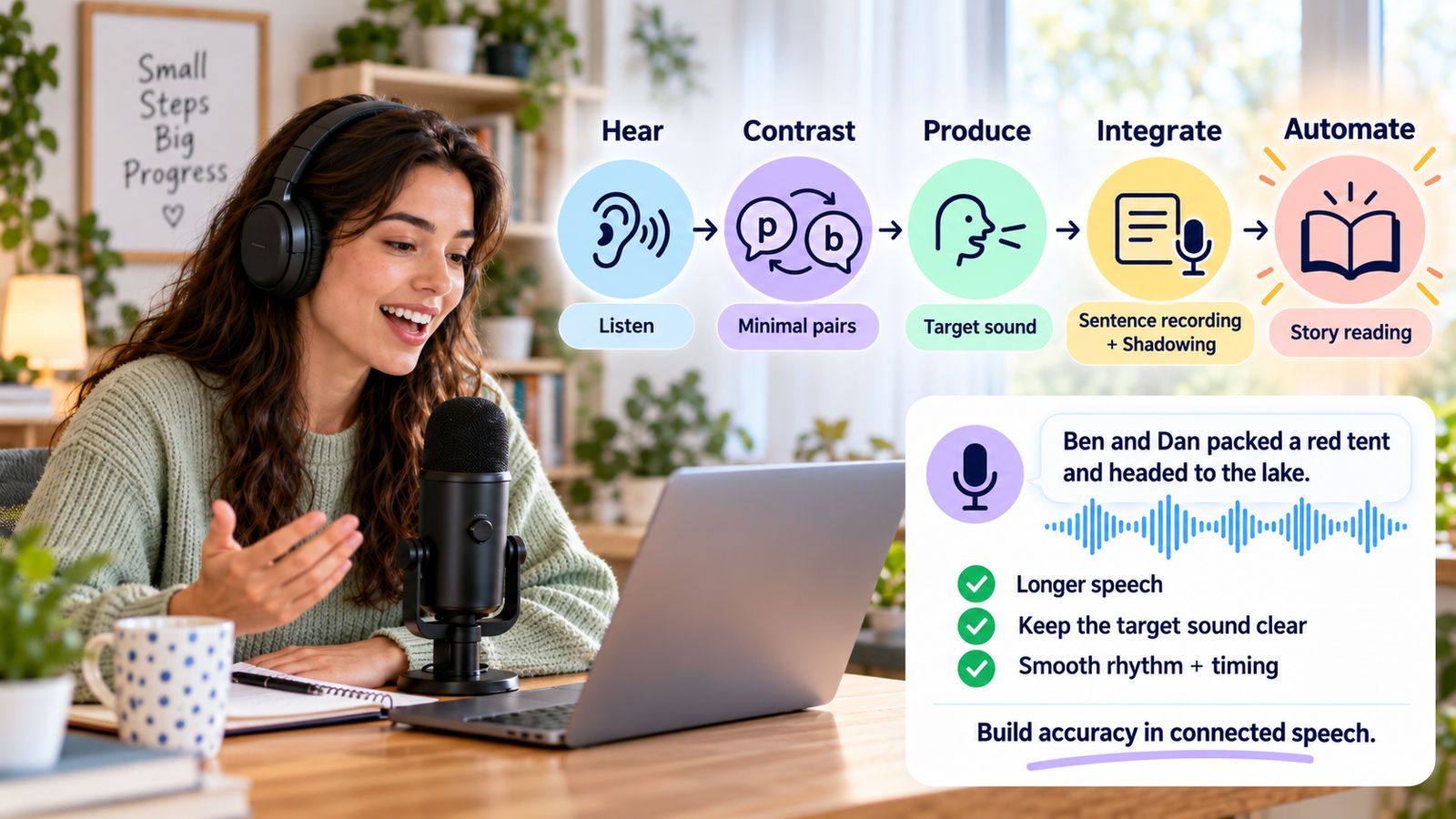
Story reading exercises increase the amount of language you need to manage while keeping the same pronunciation target accurate.
How Syranto Uses Story Reading Exercises
Syranto gives you a short, target-rich story to record aloud. You focus on the lesson's target phoneme or sound contrast while maintaining natural rhythm and intonation.
The recording is evaluated for pronunciation accuracy, clarity, speed, and timing. You can then use that feedback to make another attempt with more precise sounds and smoother connected speech.
This makes Story Reading one of the final steps from focused pronunciation drills toward more automatic English accent practice.
Frequently Asked Questions
Does reading stories aloud improve English pronunciation?
Reading aloud practice gives you repeated experience with sounds, word stress, rhythm, phrasing, and intonation. Research with EFL learners has reported improvements in areas such as pronunciation, prosody, oral reading rate, and fluency.
Why use stories for pronunciation practice?
Stories give you longer connected speech practice while still providing a fixed text. A target-rich story can repeat one difficult phoneme many times across natural sentences.
Should I read the same story more than once?
Repeated reading gives you another chance to improve difficult sounds and make the passage smoother. Research on repeated oral reading has reported gains in fluency and pronunciation-related measures.
What should I focus on when reading aloud?
Start with the target phoneme or sound contrast. Once it stays accurate, focus more closely on rhythm, intonation, phrasing, clarity, and natural speaking speed.
How does Syranto use Story Reading?
Syranto gives you a short story containing frequent examples of the target pronunciation feature. You record the passage and receive AI pronunciation feedback on accuracy, clarity, speed, and timing.
Let Syranto set you up with story reading exercises that target exactly the phonemes you neet to strengthen!
Shape your accent, we guide the way.
Reading helps you understand. Practice helps you change how you sound.
Start practicing →