Get Android
Rapid Pronunciation Drills for Clearer English Sounds
Producing two English sounds correctly once is one skill. Switching between them quickly while keeping the contrast clear is harder. Here's how it works!

Rapid pronunciation drills increase the pronunciation challenge for your English accent training drills. You repeat alternating words at increasing speed while maintaining accurate articulation. This type of English pronunciation exercise is especially useful for similar consonants, voicing contrasts, and sounds that start to blend when you speak faster.
Quick Answer: What Is a Rapid Alternation Drill?
A Rapid Alternation Drill asks you to repeat contrasting words back and forth as quickly and clearly as possible. For example:
Pat → Bat → Pat → Bat
The goal is to maintain the pronunciation difference as your speaking speed increases. Syranto then provides AI pronunciation feedback on features such as articulation and voicing.
Why Alternate Between Similar English Sounds?
Minimal pair practice teaches you to produce two sounds as separate categories. Rapid alternation practice adds a second challenge: switching between those categories quickly.
For /p/ and /b/, you might practice:
Pop → Bob → Pop → Bob
Pack → Back → Pack → Back
Peep → Beep → Peep → Beep
Each switch requires your speech system to reset the target pronunciation while keeping the words distinct.
Research supports the broader value of focused phonetic training. A 2025 meta-analysis of 65 studies involving 2,793 second-language learners found a large positive overall effect of phonetic training on L2 phonetic competence.
A rapid pronunciation drill applies that focused practice under greater time pressure.
Speed Should Never Erase the Contrast
The goal of a fast pronunciation exercise is clear speech at increasing speed, rather than speed by itself.
If pat and bat begin to sound the same, slow down. Rebuild the contrast, then increase your pace again.
The most recognizable progression is:
slow and accurate → smooth and accurate → faster and accurate
Research on repeated L2 speaking tasks supports this gradual increase. One study found that repeated oral performance increased speech rate, with the largest fluency gains appearing during the first few repetitions.
That makes repetition useful for developing faster speech once the pronunciation target is stable.
Rapid Drills Can Train Voicing and Articulation
Syranto's Rapid Alternation Drills can focus on specific pronunciation features.
For a /p/ and /b/ lesson, the learner might practice:
Pip → Bib → Pip → Bib
Pike → Bike → Pike → Bike
Cap → Cab → Cap → Cab
The exercise keeps attention on the contrast while the repeated switching increases the articulatory demand.
This makes rapid minimal pair drills useful when you can pronounce both sounds slowly but lose the distinction during faster speech.
Move From Simple Words to Harder Word Chains
Rapid pronunciation practice can become gradually more complex.
Start with short contrasts:
Pat → Bat
Then move toward longer words:
Puppy → Baby
Paper → Baker
Public → Bubble
Longer words require you to maintain the target sound while controlling more syllables and more articulatory movement.
This progression keeps the English sound contrast exercise focused while gradually increasing the speech load.
Why Pronunciation Feedback Matters
Fast repetition can make small errors harder to notice yourself.
AI pronunciation feedback scores give you another way to check whether your articulation stays accurate as your speed increases.
A meta-analysis of 15 ASR pronunciation studies found a medium overall effect on ESL/EFL pronunciation. Explicit corrective feedback produced a larger effect than indirect feedback, and ASR showed particularly strong effects for segmental pronunciation such as consonants and vowels.
That makes targeted feedback especially relevant for rapid consonant drills and voicing practice.
How to Practice Rapid Alternation
Start each word pair slowly and make the contrast obvious.
Repeat the pair several times while keeping every consonant and vowel clear. Increase your speed only when the two words remain distinct.
Then try the challenge:
repeat the chain three times at increasing speed without losing clarity.
Use your pronunciation feedback to identify where articulation begins to weaken. Slow down, correct that point, and repeat.
Where Rapid Alternation Fits Into Accent Training
Rapid Alternation belongs in the Contrast stage of accent training:
Hear → Contrast → Produce → Integrate → Automate
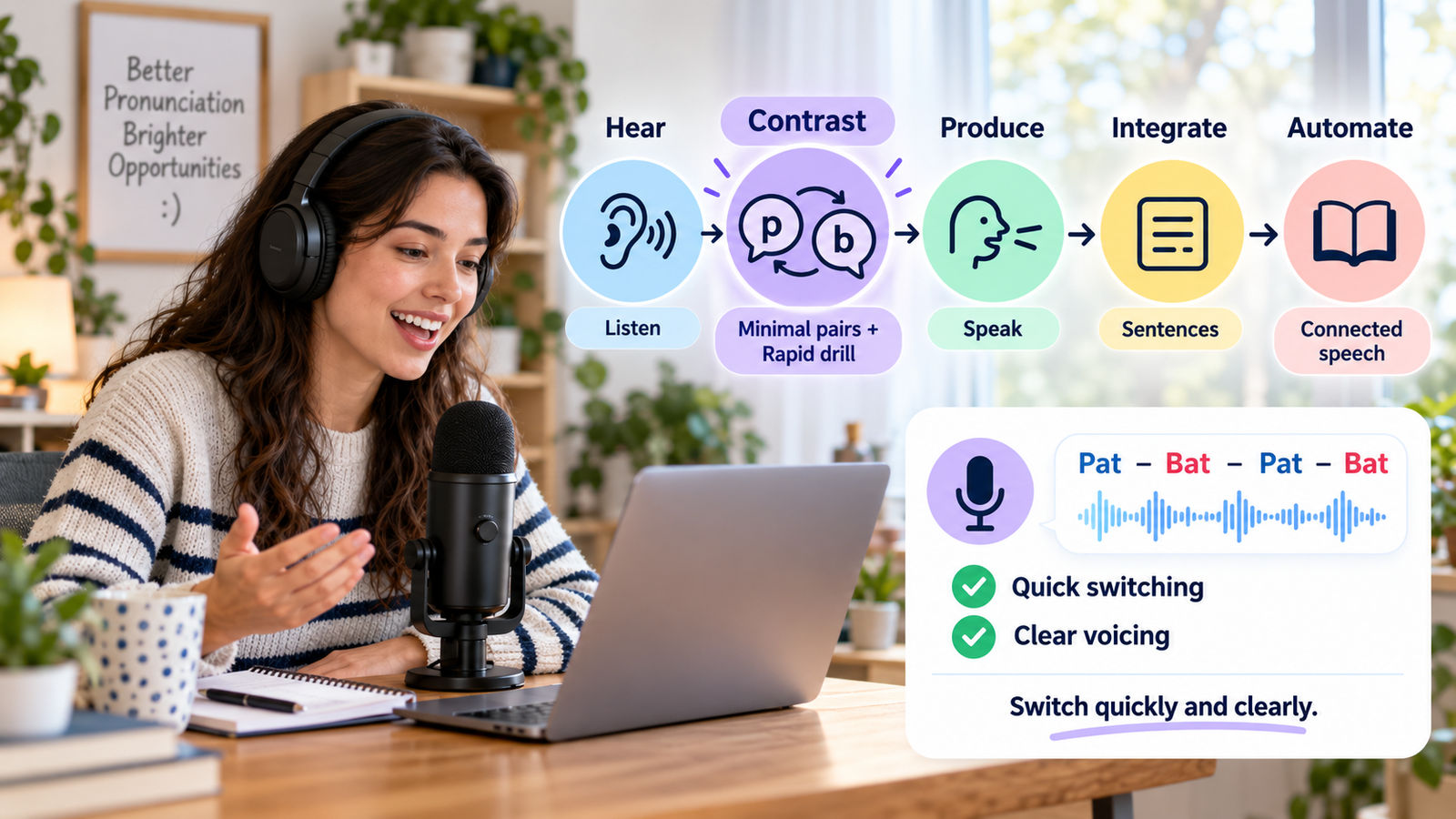
Listening exercises help you hear the difference. Minimal pairs establish two clear pronunciation patterns.
Rapid pronunciation drills then strengthen your ability to switch between those patterns quickly and accurately before you move into sentences and connected speech.
How Syranto Uses Rapid Pronunciation Drills
Syranto gives you chains of alternating words that contain two contrasting English sounds. You record the chain as quickly and clearly as you can while focusing on the lesson's articulation or voicing target.
For /p/ and /b/, that might mean:
Pat → Bat → Pat → Bat
Pack → Back → Pack → Back
Pike → Bike → Pike → Bike
Immediate AI pronunciation feedback helps you check whether the contrast stays clear as your speed increases. Recording and repeating makes your phoneme pronunciation solid over time.
Frequently Asked Questions
What is a rapid pronunciation drill?
A rapid pronunciation drill asks you to repeat contrasting words quickly while maintaining accurate articulation. It adds speed and repetition to focused pronunciation practice.
Are rapid drills the same as minimal pairs?
They are related. Minimal pair exercises establish a clear contrast between two sounds. Rapid Alternation Drills repeatedly switch between contrasting patterns while gradually increasing speed.
Can pronunciation drills improve speaking speed?
Repeated speaking practice can increase fluency and speech rate. Research on repeated L2 speaking tasks found improvements in oral fluency across repeated performances.
Should I practice pronunciation quickly or slowly?
Start slowly enough to produce each sound accurately. Increase your speed gradually while keeping the contrast clear.
How does Syranto use Rapid Alternation Drills?
Syranto gives you alternating word chains to record at increasing speed. You focus on a specific sound contrast and receive immediate feedback on your English pronunciation, articulation, and voicing.
Let's get started with rapid alternation drills to target the phonemes that need the most practice!
Shape your accent, we guide the way.
Reading helps you understand. Practice helps you change how you sound.
Start practicing →