
 Get Android
AI Pronunciation Feedback: What a Five-Week Study Found
Check out the results of this experiment, and see how these scientific results can help you improve your English accent!

You record a sentence in a pronunciation tool and receive a score of 68%. You know the sentence needs work, but the score leaves one important question unanswered: What should you change?
A 2024 study suggests that targeted feedback is the answer! Researchers compared two automatic speech recognition systems for English pronunciation practice. Both helped learners improve, but the system that identified individual sound errors produced stronger gains than the system that only gave a general score.
What Does Research Say About Targeted Pronunciation Feedback?
AI pronunciation feedback can support English pronunciation improvement. In a five-week study of 117 Indonesian high school students, learners improved with both general and phoneme-level feedback. However, the group that received detailed feedback on individual speech sounds made much greater progress in word accuracy, accentedness, and comprehensibility.
What Did the Study Examine?
The researchers worked with Indonesian vocational high school students who were mainly at A1 or A2 English level. Most rarely spoke English outside school, and many described speaking English as difficult.
The students practiced for five weeks through one of two automatic speech recognition systems:
The general-feedback system gave a percentage score and a broad message such as “You got it!” or “You could use some practice.”
The phonetic-feedback system evaluated individual phonemes. It showed whether each sound matched the target closely, came near the target, or differed from it. It also offered sound explanations, audio models, recording tools, and phoneme-level practice.
The students practiced words, phrases, and short spoken responses. Before and after the program, they recorded 28 words and 28 sentences.
Study feature | Details |
|---|---|
Participants | 117 Indonesian high school students |
English level | Mainly A1–A2 |
Training period | Five weeks |
General-feedback group | 52 students |
Phonetic-feedback group | 65 students |
Main measures | Phonetic distance, accentedness, comprehensibility |
The researchers used phonetic transcriptions to measure word-level accuracy. Nine raters also judged how strongly accented the sentences sounded and how easy they were to understand.
What Did the Researchers Find?
Both groups improved their pronunciation.
Students showed progress in most of the target words, and their sentence-level speech became easier to understand. Their accentedness scores also improved.
The phonetic-feedback group made greater progress across all three measures.
Pronunciation measure | General feedback | Phonetic feedback |
|---|---|---|
Word-level phonetic-distance gain | 0.0145 | 0.0232 |
Accentedness gain | 0.650 | 0.891 |
Comprehensibility gain | 0.524 | 0.755 |
[Note: Each row uses a different measurement scale, so the figures should be read within that row.]
Here’s the important pattern: the phonetic-feedback group achieved the larger gain.
The researchers also found a strong relationship between accentedness and comprehensibility. However, the two remained distinct. A learner could still sound clearly non-native while being easy to understand.
Why May Detailed Pronunciation Feedback Work Better?
A general score tells you whether the system accepted your pronunciation. Detailed pronunciation feedback helps even more: it tells you where the problem occurred.
Suppose you pronounce “version” with /f/ in place of /v/. A broad score may tell you to try again. Phoneme-level feedback can direct your attention to the first consonant specifically.
That difference gives you a practical correction target:
Listen to a clear model → speak and record the target word or phrase → identify the problem sound → adjust your mouth or voicing → repeat
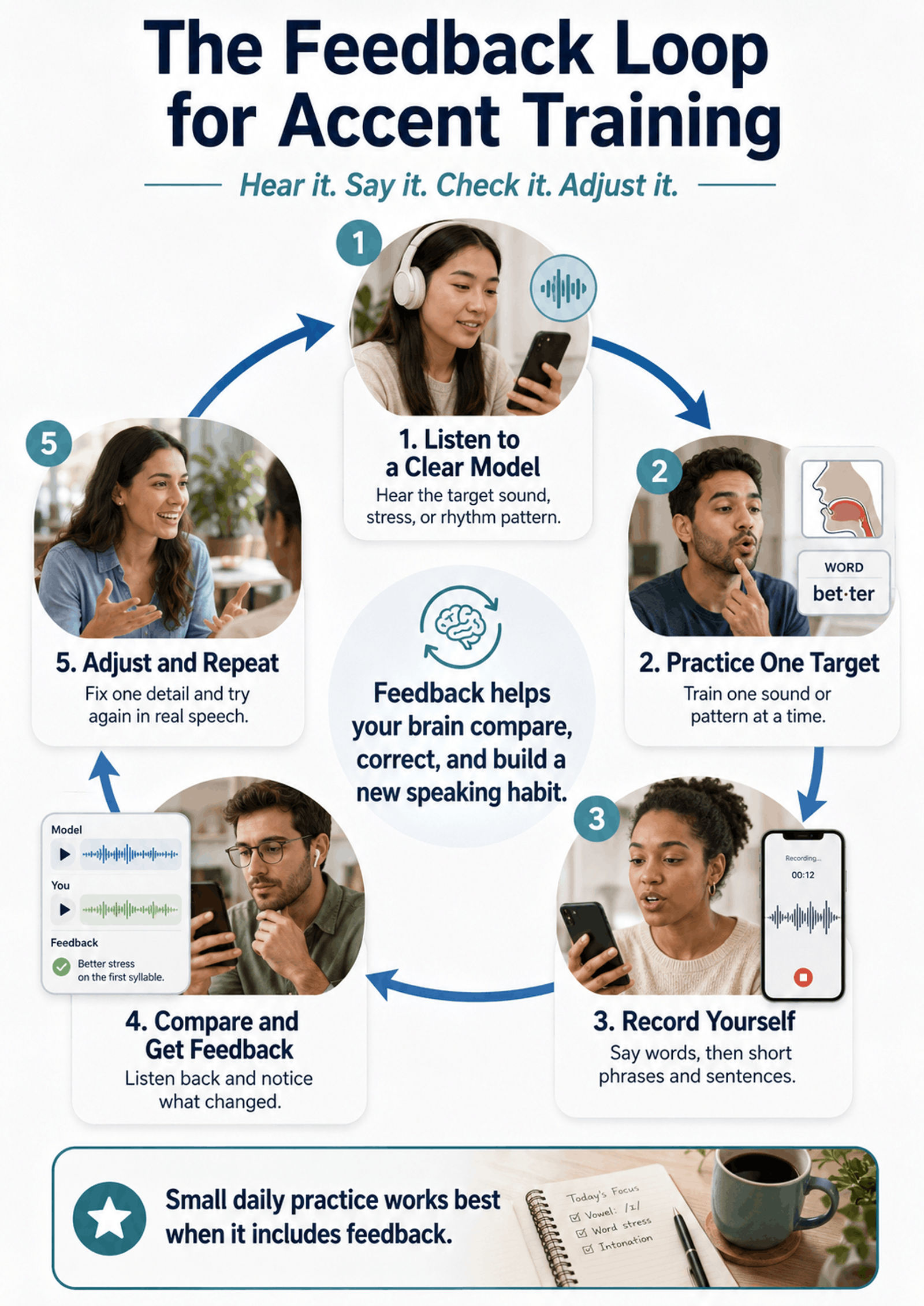
The researchers connect this process to the noticing hypothesis. Learners need to become aware of the gap between their own speech and the target pronunciation before they can make a focused adjustment.
Immediate pronunciation feedback may also help because the original attempt remains fresh in your memory. You can repeat the word while you still remember how it felt and sounded.
Why This Matters for English Learners
Pronunciation practice becomes more productive when each repetition has a purpose.
A score can help you track progress over time. Detailed feedback can guide the next step in your practice. It may show that you need to work on one vowel, a missing final consonant, misplaced word stress, or a sound that differs from the spelling.
The study’s expert transcriber observed that many students appeared to have learned English words mainly through reading. Some pronounced words according to familiar spelling patterns from their first language.
For example, students often pronounced the final letters of “enough” as though the word ended in /g/, even though its standard English pronunciation ends in /f/.
It’s a common pronunciation problem: English spelling often gives an incomplete picture of speech. Listening, recording, and sound-specific feedback can help connect the written word to its spoken form.
How to Practice With AI Pronunciation Feedback
Use this daily pronunciation practice routine with one word or short sentence at a time.
Listen to a clear model. Focus on one sound, stress pattern, or final consonant.
Record your first attempt. Speak naturally without stretching every sound.
Read the feedback carefully. Find the specific part that needs attention.
Study the target sound. Check the mouth position, airflow, and voicing.
Repeat the word three times. Make one deliberate adjustment.
Place the word in a sentence. Practice the sound in connected speech.
Record again. Compare the new attempt with the first one.
Feedback shows… | Your next action: |
|---|---|
One sound differs | Practice that sound in a minimal pair |
Final consonant is weak | Release the final sound clearly |
Stress falls on the wrong syllable | Mark the stressed syllable before speaking |
The sentence is hard to understand | Divide it into short thought groups |
The whole word is unclear | Listen again and practice it syllable by syllable |
The central lesson is simple: useful pronunciation feedback should identify a specific problem and give you a clear target for your next attempt.
How Syranto Can Help
Syranto analyzes your speech at the sound level, helps identify which phonemes need attention, and directs you toward targeted practice.
For example, a general score may show that a word needs work. Syranto can help narrow the problem to a specific consonant, vowel, stress pattern, or timing feature. You can then focus on that feature, repeat the word, and practice it again in a phrase or sentence.
Syranto supports this process through:
Sound-level pronunciation analysis
Targeted exercises for weak phonemes
Immediate feedback after each attempt
Repeated practice with words and sentences
Progress tracking across pronunciation features
The goal is to turn feedback into action!
Frequently Asked Questions
Does AI pronunciation feedback work?
This study found significant pronunciation improvement after five weeks of automatic speech recognition practice. Both feedback systems helped, although detailed phonetic feedback produced greater gains.
Is phoneme-level feedback better than a pronunciation score?
In this study, the group receiving phoneme-level feedback improved more than the group receiving general scores. More research is needed across different learners, languages, and speaking tasks.
Can AI pronunciation practice replace a teacher?
The study did not test that question. Automatic feedback can provide frequent, private, and immediate practice, while teachers can support communication, motivation, and broader speaking development.
What should useful pronunciation feedback tell me?
Useful feedback should identify the sound or speaking feature that needs attention and give you a clear next action. A number shows your result. A diagnosis shows you what to practice.
The Syranto app can provide you with the phoneme-level feedback that leads to scientifically-proven results. Get started today!
Shape your accent, we guide the way.
Reading helps you understand. Practice helps you change how you sound.
Start practicing →