
 Get Android
AI Feedback for Pronunciation Errors: Did You Say “Dough” or “Dome”?
Here's what the scientific research shows us about AI pronunciation feedback, plus a guide to help you use these tools in the most effective way possible. Use this research to improve your English accent.

A photographer sends you two pictures from a bakery. One shows the dough on a wooden board. The other shows the dome of the brick oven. You leave a voice message: “Use the photo of the dome.” Which picture will the photographer choose?
That last consonant sound makes all the difference. Your lips come together for the /m/ in dome. The word dough ends with the vowel.
AI feedback for pronunciation errors can draw your attention to a difference like this. The useful part comes next: can you make the difference clear to somebody who hasn’t seen your script?
How AI Pronunciation Feedback Can Help
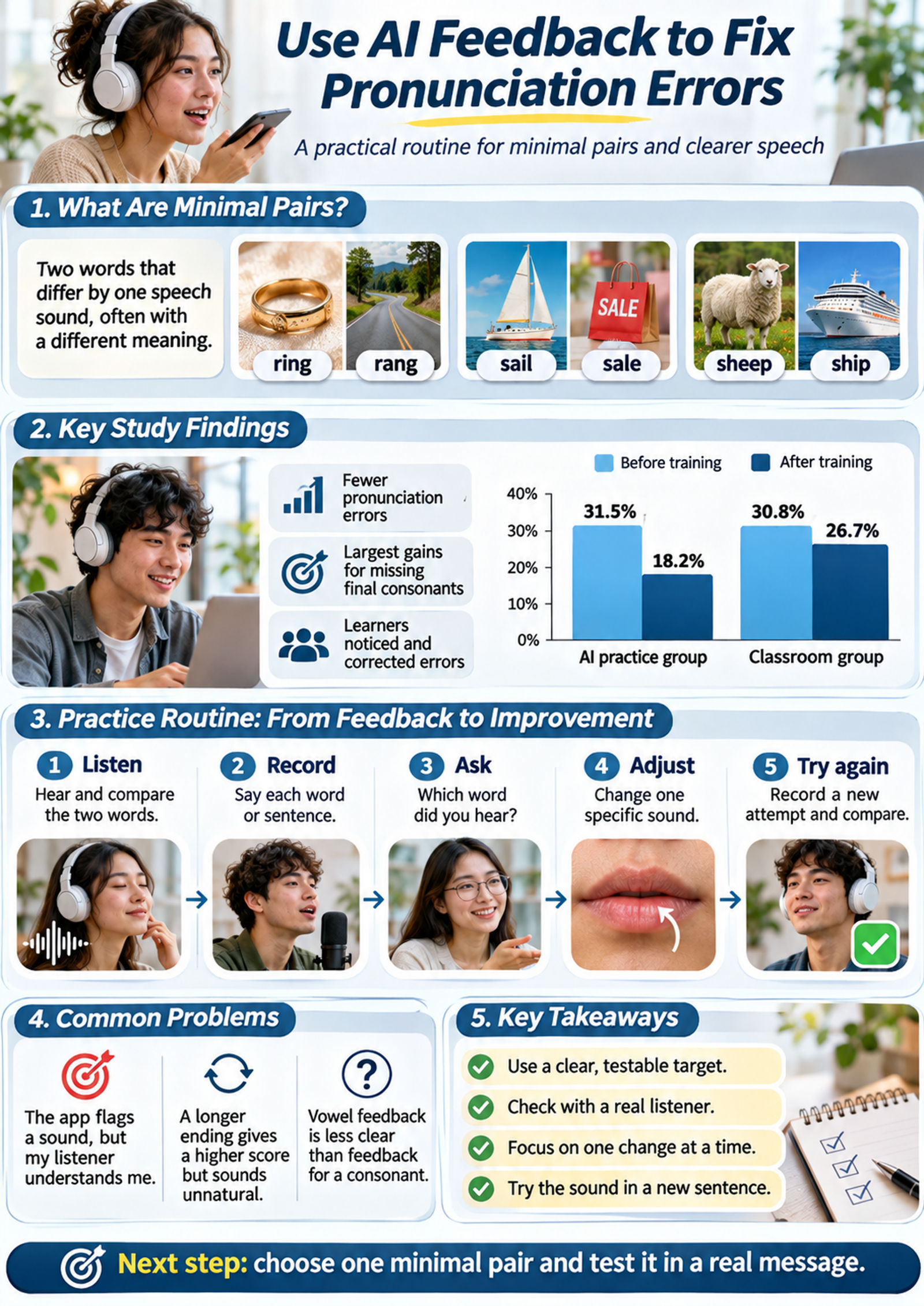
Use AI feedback for pronunciation errors to find one sound worth checking. Record two words that differ at the ending, then ask a listener which one they heard. Try the same contrast in a new sentence. Keep track of the words your listener identifies, especially when their answer differs from the feedback on your screen.
Making the Most of This AI Pronunciation Feedback
Final consonant omission means leaving out a consonant at the end of a word. Sometimes the result sounds like another English word. Dome without its final /m/ can sound like dough. A listener who knows you’re talking about a bakery has a good reason to hear either one.
This gives your pronunciation practice a fair test. “Use the photo of the ___” works with both words. Your listener has to pay attention to your English pronunciation to choose the picture.
What Happened in the ELSA Speak Study?
Vuong Thi Hai Yen and Pham Vuong Ha Anh studied 105 Vietnamese first-year English majors, aged 18–19, at B1–B2 level. They compared two existing groups without randomly assigning students.
Students read words and sentences aloud. Two raters marked individual sound errors.
One group received three weeks of ELSA Speak practice, assigned at 20 minutes daily. The other continued classroom practice.
Researchers repeated the reading test in week four and gathered learner perspectives through a questionnaire and 15 interviews.
Mean Sound Error Rate | Before | After | Drop |
|---|---|---|---|
ELSA Speak (53 learners) | 31.5% | 18.2% | 13.3 percentage points |
Classroom practice (52 learners) | 30.8% | 26.7% | 4.1 percentage points |
The posttest difference was statistically significant (p < .01; reported Cohen’s d = 0.85). Learners described noticing previously missed errors; some found complex feedback hard to interpret.
Did endings improve most? The authors saw the clearest pattern for final consonant omission. But their category breakdown compares both groups combined before training with only the app group afterward. Missing practice records also prevent a reliable comparison of practice time. The overall reading results are promising; the study cannot isolate feedback’s effect or establish gains in conversation.
How to Test AI Feedback for Pronunciation Errors
AI feedback for pronunciation errors gives you a place to start. Suppose your app flags the end of dome. Write down its actual comment in your English pronunciation notes. Then write a question you can answer: “When I say dome, does someone hear dough?” You now have a way to check whether the flag points to a real misunderstanding.
Try these original examples for targeted sound practice. They are teaching examples, separate from the research test.
Word Ending in a Vowel | Word with a Final Consonant | What to Listen For |
|---|---|---|
dough | dome | Do your lips close for /m/ after the vowel? |
tray | trace | Can you hear the hiss of /s/ at the end of trace? |
glee | gleam | Can you keep the /m/ in a new word? Glee means joy; a gleam is a small flash of light. |
Start with one row to work on English consonant pronunciation. If you switch sounds after every attempt, it becomes harder to tell which adjustment helped. The minimal pair exercise guide explains how to build pronunciation practice around a single difference.
English Pronunciation Practice: Give Your Listener a Real Choice
Listen to both words. Use Syranto’s Vocalize feature to hear “Use the photo of the dough” and “Use the photo of the dome.” Choose the same voice for both. Listen once with the text visible, then replay the endings with your eyes closed.
Make two recordings of each sentence. Use your phone’s recorder and keep a private answer key. Give the four audio clips numbers and mix their order. Your partner should hear your English pronunciation before seeing any answers.
Ask for the word they heard. “Which photo did I ask for?” is more useful than “Was my accent good?” Mark the answer next to each clip number. If dough comes through twice but dome sounds like dough both times, you have a specific accent training target.
Change one movement. Say dome slowly. Let your lips meet while your voice continues briefly for the final /m/, then stop. Keep it one syllable. Record it again at a comfortable pace. Listen for the ending without adding an extra “uh.”
Try a fresh message. Set the pictures aside. Tell your partner what you liked about the oven: “I liked the shape of the dome.” Later, try glee/gleam without rehearsing them first. Note whether the ending carries over into this new word.
This is an informal pronunciation practice routine. Four clips can reveal something useful about today’s recordings; they cannot measure your whole accent. For a record you can revisit, follow the sentence recording exercise and keep the audio with your notes.
Common Problems with AI Feedback for Pronunciation Errors
The app flags a sound, but your listener hears the intended word. Keep the AI pronunciation feedback alongside your listener’s answer. Your listener may have used clues from the sentence, or the tool may have flagged a difference that did not affect meaning. Record a second sentence that fits either word before you make this an accent training priority.
You get a better score by stretching the ending. English consonant pronunciation can sound quite different in a full sentence. Try the word at your ordinary speaking pace. The goal of English pronunciation practice here is to make dome recognizable in a message. If a long hum earns a higher score but breaks the rhythm of your sentence, use the sentence recording to decide what to practice next.
The same advice makes less sense for a vowel. A comment about missing /m/ gives you a movement to check. A comment such as “vowel unclear” leaves more work to do. Ask a teacher to model the contrast and play the examples in a mixed order. Can you identify them? Your answer helps you decide whether to start with listening or speaking.
Frequently Asked Questions
Can AI feedback for pronunciation errors tell me which sound to fix first?
Look for agreement between the AI pronunciation feedback and an actual misunderstanding. A word that a partner repeatedly hears as something else makes a useful first target. Bring a persistent flag to a teacher if you cannot hear what the app means.
How can I track pronunciation mistakes without counting every word I say?
Choose one ending and count opportunities to use it. “My partner heard /m/ in three of four intended words” tells you more than “I made one mistake.” Keep the task and the number of attempts in your notes. A short log can show which pronunciation mistakes return when the sentence changes. For targeted sound practice, label each clip “rehearsed” or “fresh.” That way, you can see whether a familiar word still causes trouble when you have a new idea to explain.
Which app provided the feedback in this study?
The researchers used ELSA Speak. You can use Syranto for model audio, record your own voice separately, and compare what you hear with any AI pronunciation feedback you receive. The pronunciation feedback loop gives you a structure for that comparison.
Choose one useful word for your next accent training session. Start with the bakery message. If your partner picks the photo you meant, try a new sentence. If they pick the other photo, you know exactly which sound to listen to next.
Reference
Vuong Thi Hai Yen & Pham Vuong Ha Anh (2026). Differential responsiveness to AI-mediated feedback in EFL segmental pronunciation learning. Technology in Language Teaching & Learning, 8, 104879.
Syranto has got you covered with a full library of minimal pairs and final consonant pronunciation exercises!
Shape your accent, we guide the way.
Reading helps you understand. Practice helps you change how you sound.
Start practicing →