
 Get Android
Why Pronunciation Practice Fails Without Feedback (And How to Fix It)
Do you find yourself spending hours on pronunciation practice, but still hear the same English pronunciation mistakes again and again? This happens because speaking practice without feedback does not change how you speak. Let’s look at the proven ways to practice pronunciation with real results!
The Real Problem: Why Pronunciation Practice Alone Doesn’t Work
Think about the problem from a different perspective: speech is actually a physical skill, just like any gym exercise or sports move. You use muscles in your tongue, lips, and jaw to produce sounds; there’s a strong connection between muscle memory, speech learning, and speech feedback for English learners. Without pronunciation feedback, your brain cannot tell if those movements are correct.
Over time, pronunciation training without feedback creates stable but incorrect speech habits. Research in motor learning confirms that skills improve only when learners receive information about errors and adjust to correct their English pronunciation mistakes.
Pronunciation Training Without Feedback Reinforces Errors
When you repeat words or sentences without a feedback loop, language learning gets harder. Your brain, with limited phonetic awareness English, accepts those sounds as correct. This is one of the English accent improvement methods known as error reinforcement. In phonetics research, repeating the same English pronunciation mistakes again and again can lead to long-term patterns that are difficult to change later.
For example, if a learner says “think” as /tɪŋk/ instead of /θɪŋk/, and no one corrects these English pronunciation mistakes, that incorrect sound becomes automatic. Each repetition strengthens the same neural pathway. Over time, the learner feels confident, even though the pronunciation stays wrong.
Speaking Practice Without Correction Leads to No Progress
Many learners believe that by simply speaking more -- even without deliberate practice -- pronunciation will naturally improve. Of course, speaking practice is important, but speaking practice without feedback does not lead to measurable improvement. Research on language learning shows that learners who receive corrective pronunciation feedback improve significantly more than those who only practice speaking.
When you do pronunciation training without feedback, two problems happen:
You repeat the same mistakes.
You do not notice those mistakes.
This creates a false sense of progress, and it’s a big reason why pronunciation practice fails. You may feel more comfortable speaking, but your English pronunciation mistakes do not change. In other words, fluency may increase, but clarity does not.
To improve spoken English clarity, your accent training strategy must include external input: someone or something that tells you what is correct and what is not.
Self-Study Pronunciation Problems Most Learners Ignore
Self-study is popular because it is flexible and accessible. However, most self-study pronunciation problems start quickly, since they do not provide reliable pronunciation feedback.
Common problems include:
Listening without checking your own production
Repeating after audio without comparing accuracy
Using apps that do not detect specific pronunciation errors
Research shows that learners often have low phonetic awareness English, which means they cannot accurately judge their own speech sounds.
For example, a learner may believe they are producing the correct vowel sound in “ship” vs “sheep”, but without pronunciation feedback, they may not hear the difference clearly. This gap between perception and production slows progress.
What Happens Without Pronunciation Feedback? The Science of Pronunciation Practice Explained
Pronunciation is a sensorimotor skill, so it depends on both movement and perception. When you speak, your brain sends instructions to your speech muscles, and at the same time, it monitors what you hear. This system allows you to adjust your speech in real time.
Without real-time, accurate pronunciation feedback, this whole system breaks down. Your brain continues to produce speech, but it can’t receive reliable information about errors. As a result, incorrect patterns become normal to you. Over time, these patterns feel correct, even when they are not.
Muscle Memory in Speech Learning Forms Incorrect Patterns
Speech is all about muscle memory, just like playing a musical instrument or learning a sport. When you repeat a sound, your brain strengthens the neural pathways that control those movements. This process is called “motor learning.”
However, motor learning does not distinguish between correct and incorrect actions. It simply reinforces what you repeat. Research in motor skill acquisition shows that repetition without pronunciation feedback leads to the consolidation of self-study pronunciation problems.
For example, if you consistently mispronounce the /θ/ sound as /s/ or /t/, your brain builds a stable motor pattern for the wrong sound. Each repetition makes that pattern faster and more automatic. Over time, it becomes difficult to change because the incorrect movement feels natural.
The Role of Auditory Feedback: Speech Production Comes From Listening
Auditory feedback (AKA your ability to hear your own voice and compare it to a target sound) is the key to correct speech production. The brain uses auditory input to detect differences between intended and actual speech, then adjusts accordingly.
Basically, you learn to speak by listening -- both to yourself and to others. But for many English learners, this system doesn’t always work effectively, even if you have tons of native-speech input. There are a few reasons for this, which can include:
Your brain is tuned to the sound system of your first language
You may not hear subtle differences in English sounds
You rely on incorrect internal models of pronunciation
Interference or confusing sounds from your mother language can impact how you hear English phonetics. Then, this listening error leads to pronunciation errors.
The Feedback Loop in Language Learning: Why It Matters
The feedback loop is the process that helps you learn and train an accent. It describes the steps that you’ll take as you improve English pronunciation clarity with targeted and long-term ESL pronunciation drills.
Without this English learning feedback loop, learning lacks deliberate practice; pronunciation training without feedback is passive. You may repeat sounds many times, but no meaningful change occurs because there are no pronunciation correction techniques. You need the feedback loop to change pronunciation practice into progress!
What Is the Feedback Loop in Language Learning?
The feedback loop for language learning looks like this:
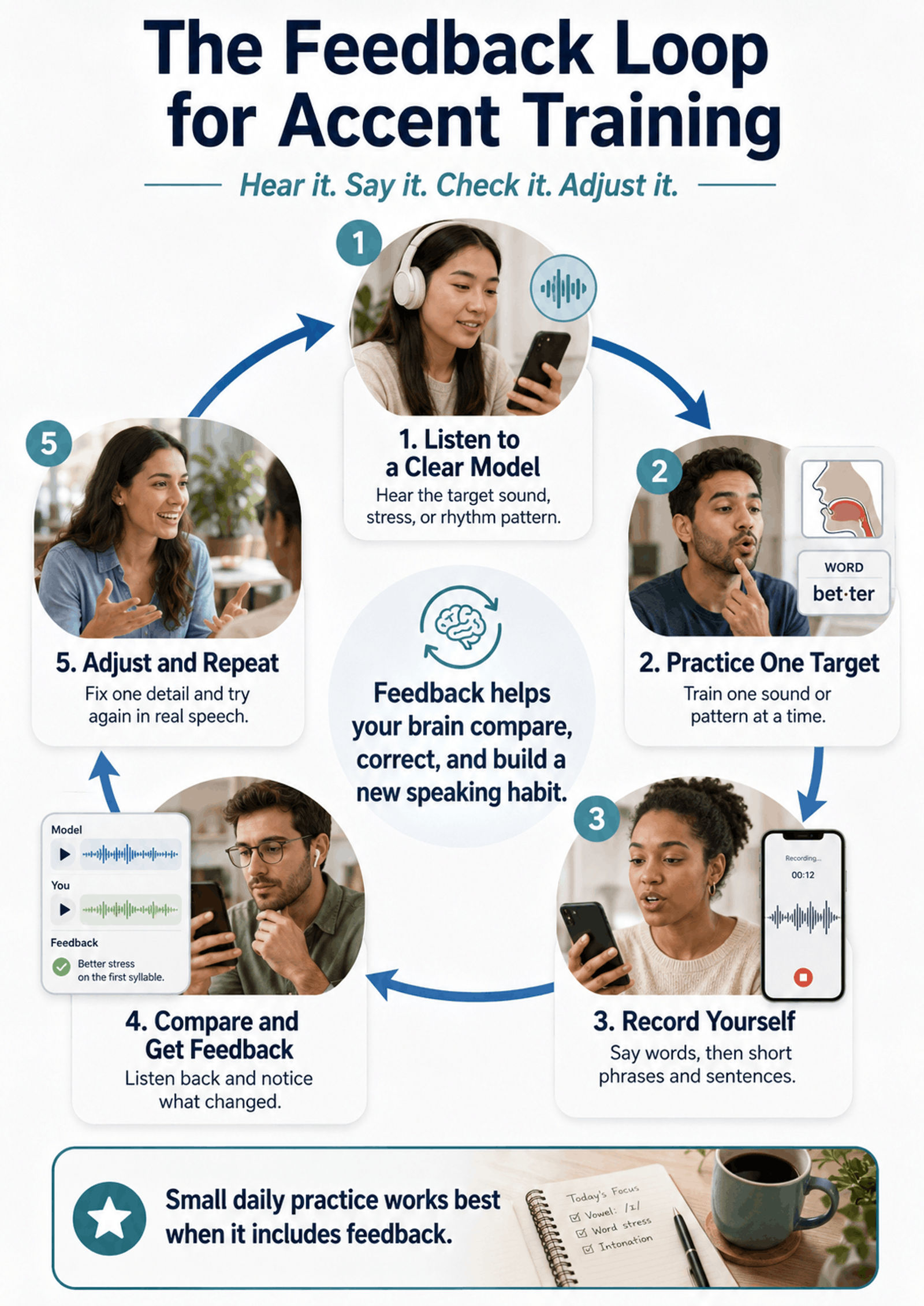
In the feedback loop, language learning connects input, output, and correction. You hear a model (input), produce speech (output), and then compare the two through feedback.
This comparison is critical to improve English pronunciation. It helps you:
Notice differences between your speech and the target
Identify specific pronunciation errors
Adjust your articulation in future attempts
According to research in English accent improvement methods, learners who receive consistent feedback develop more accurate pronunciation because they can fine-tune their speech over time.
In contrast, pronunciation training without feedback relies on guesswork. They repeat sounds without knowing if they are correct, which slows or stops improvement. That’s why pronunciation practice fails when it doesn’t include the feedback loop in the accent training strategy.
Why Pronunciation Training Without Feedback Fails Long-Term
In the short term, speaking practice without feedback may increase confidence. You may feel more comfortable speaking because you repeat familiar patterns. However, long-term results are limited.
Without the right pronunciation correction techniques, errors become automatic, incorrect patterns stabilize, and you hit improvement plateaus. This is called “fossilized pronunciation errors,” where incorrect language forms and pronunciation become features of your English speech.
Long-term studies in pronunciation training show that learners who receive feedback achieve significantly higher accuracy than those who practice without it. It’s not a lack of effort that explains why pronunciation practice fails! Instead, it fails because the learning system is incomplete without pronunciation feedback.
How to Improve English Pronunciation (Step-by-Step With Feedback)
Follow these steps for a practical system that you can apply immediately. Remember, each step builds on the previous one!
Step 1: Record Your Speech
First, make your pronunciation observable. Basically, you need to record your speech so that you can hear it from the outside, or externally. If you’re trying to listen to your own pronunciation while you’re speaking, you’re more likely to mishear or misjudge your own pronunciation.
What to do:
Choose a short sentence or word list.
Record yourself clearly (phone or computer is enough).
Speak naturally, not slowly or artificially.
Why this matters:
Recording separates what you think you said from what you actually said.
Step 2: Compare with the Model
After you record your speech, you need to compare it to a target model. This could be a native speaker in a video or recording, a dictionary audio example, or any high-quality pronunciation resource.
What to do:
Play the model audio.
Play your recording immediately after.
Focus on specific features:
vowel sounds
consonants
stress patterns
rhythm and intonation
Why this matters:
Your brain learns by contrast. Without comparison, you cannot identify what needs to change.
Step 3: Identify Errors
Be brutally honest as you compare your recording to the model/example. General awareness is not enough. You need to know what is wrong and where.
What to look for:
Sound substitutions (e.g., /θ/ → /t/)
Incorrect vowel length or quality
Missing word stress
Flat or incorrect English intonation
Example:
Target: “record” (noun) → /ˈrek.ɔːd/
Your version: stress on second syllable → error in stress pattern
Why this matters:
If you cannot identify the error, you cannot fix it. This step transforms vague pronunciation training without feedback into precise training to improve English pronunciation.
Step 4: Correct the Errors and Repeat
Once you identify errors, you must actively correct them. This is where real learning happens!
What to do:
Focus on one error at a time
Slow down your speech
Exaggerate the correct sound if needed
Repeat the corrected version several times
Record again and compare
Why this matters:
Proper pronunciation correction techniques rewire your speech patterns. Each accurate repetition strengthens the correct motor pathway. Over time, this replaces incorrect habits and fossilized pronunciation errors.
Step 5: Reinforce Correct Production
Now it’s time for reinforcement! Once you can produce a sound correctly, you have to stabilize it through repetition in different contexts.
What to do:
Practice the corrected sound in multiple words.
Use it in full sentences.
Repeat the ESL pronunciation drills across different days.
Continue using pronunciation feedback to verify accuracy
Why this matters:
A single correct attempt is not enough to improve English pronunciation. Without reinforcement, your brain may return to old patterns. Reinforcement builds automatic, reliable pronunciation.
Accent Training With Feedback: What Actually Works
Most learners already do pronunciation training with feedback, whether it’s deliberate practice, pronunciation exercises from a teacher, or just repeating words and phrases that they hear from native speakers.
The difference between slow progress and real improvement comes from how that pronunciation practice is structured. Here are the top tried-and-true English accent improvement methods.
Guided Correction
Guided correction means you do not rely on guesswork. You receive clear information from professional outside sources about what is wrong and how to fix it.
Feedback needs to be explicit and focused on specific errors; general comments aren’t effective! For example, focusing on one vowel sound or stress pattern at a time can lead to better results.
Overall, guided correction allows you to focus on one problem at a time, understand exactly why the problem is happening, and apply precise adjustments. This keeps your accent training focused, efficient, and effective.
Repetition with Instant Adjustment
Repeating after a model or example is most effective when it includes instant adjustment. In motor learning, improvement depends on correcting errors immediately after they occur. Delayed correction weakens the learning effect, and weakens your pronunciation correction techniques.
For your pronunciation training, you first produce a sound (or a speech example). Then, you receive feedback right away. Before your next attempt to say the example again, you adjust your speech according to the immediate feedback.
This rapid cycle strengthens correct speech patterns. It prevents incorrect habits from forming and helps you build accurate muscle memory.
Remember: repetition without adjustment builds fluency; repetition with adjustment builds accuracy.
Tracking Progress Over a Long Time
Pronunciation improvement is gradual. It requires consistent tracking over time to improve English pronunciation. Without tracking, learners often underestimate errors or fail to notice progress.
Research in skill acquisition shows that long-term improvement depends on ongoing real-time accent feedback and performance monitoring. Tracking allows you to:
Identify recurring pronunciation problems
Measure improvement in specific sounds
Stay consistent in your pronunciation practice
For example, recording your speech weekly can reveal changes in muscle memory, speech learning, and clarity that are not obvious day-to-day.
Structured Systems and Targeted Training
Effective accent training uses a structured system, not random ESL pronunciation drills. This system focuses on high-impact areas such as vowel accuracy, consonant clarity, and stress patterns.
The Syranto app provides the target training that helps you prioritize your most important errors, practice with clear goals, and avoid wasting time on low-impact activities.
The Fastest Way to Improve Pronunciation: Feedback-Driven Training
The fastest way to improve English pronunciation is through feedback-driven training. Don’t waste your time with methods of pronunciation training without feedback!
This approach combines all the elements above:
Guided correction
Immediate adjustment
Consistent tracking
Structured pronunciation practice
Research consistently shows that regular speech feedback for English learners can help achieve higher pronunciation accuracy and better communication outcomes.
Feedback does not just help—it accelerates learning by making every practice session more effective!
From Practice to Progress: Building a Feedback-Based System
To move from pronunciation practice to really improve English pronunciation, you need a system built on feedback. This system follows a simple loop:
Produce speech
Receive real-time accent feedback
Adjust your pronunciation
Repeat with correction
This loop aligns with how the brain learns complex skills. It connects perception, action, and correction into a continuous process.
How Syranto Helps You Improve Pronunciation With Real Feedback
Syranto is designed to support this exact process. It provides speech feedback for English learners so you can identify and correct errors as you practice.
With Syranto, you can:
Detect specific English pronunciation mistakes
Receive immediate correction
Practice targeted sounds and patterns
Track your improvement over time
This creates a complete feedback loop inside your training. Instead of guessing, you work with clear, actionable information.
The result is simple: more efficient practice and faster improvement in pronunciation clarity.
Check out Syranto to start your personalized journey towards a smoother and more natural English accent!
Shape your accent, we guide the way.
Reading helps you understand. Practice helps you change how you sound.
Start practicing →