
 Get Android
The Feedback Loop You Need to Make Your Pronunciation Practice Effective:
Pronunciation practice fails when learners repeat sounds without knowing what went wrong. Learn how feedback helps you notice errors, adjust speech, and improve English pronunciation faster.
You can practice English pronunciation every day and still feel stuck.
You repeat words. You watch videos. You copy native speakers. You record yourself once or twice. Yet the same pronunciation mistakes keep coming back!
The problem may not be effort; it’s actually missing feedback.
Pronunciation practice without feedback is like throwing darts in a dark room. You can throw again and again, but you cannot see where the dart landed. You may work hard, but your brain gets very little useful information.
Feedback changes the whole practice system. It shows the gap between the sound you wanted and the sound you produced. That gap tells your ear, brain, and mouth what to fix next.
Quick Answer: Why Does Pronunciation Practice Fail Without Feedback?
Recent research in English pronunciation practice proves that it fails without feedback. Often, learners cannot hear the difference between what they meant to say and what they actually said. Feedback shows you that gap. It tells you which sound, stress pattern, rhythm, or mouth movement needs attention, so each practice attempt becomes a chance to adjust instead of repeating the same mistake.
Why This Matters for English Learners
Repetition helps for pronunciation practice, but only when you repeat the correct target. If you repeat the wrong sound 50 times, your mouth learns the wrong habit more deeply.
Good pronunciation feedback gives you a correction signal. It helps you answer four questions:
What did I say?
What did the listener hear?
What part of my speech caused the problem?
What should I change next?
These questions matter because English pronunciation depends on many small details. A short vowel can change a word. A missing final consonant can confuse a sentence. A stress shift can change meaning. A flat rhythm can make clear words sound unnatural.
For example:
“bit” and “beat” differ by vowel length and vowel quality.
“light” and “right” differ by tongue shape and movement.
“PREsent” and “preSENT” differ by word stress.
“I said SHE called” and “I said she CALLED” differ by sentence stress.
English pronunciation practice works best when you combine clear sound knowledge, active practice, and feedback. That is the core training loop.
Pronunciation Is a Feedback Loop, Not a Memory Drill
Many learners just hear and repeat a word, then repeat it again and again and hope it sounds better. But that model misses the most useful part of practice: the comparison.
A stronger pronunciation feedback loop looks like this:
You hear the target.
You say the word or sentence.
You receive feedback.
You compare your output with the target.
You adjust one feature.
You try again.
The target gives your brain a goal. Your attempt gives your brain an example of your current speech. Feedback shows the distance between the two.
For example, a learner may say “thin,” but the listener hears “tin.” A learner may say “very,” but it sounds like “berry.” A learner may say each word clearly, but the full sentence still sounds stiff.
Feedback tells the learner what happened. Better feedback also tells the learner what to change.

Why Your Brain Misses Its Own Pronunciation Mistakes
Your brain already knows your message before you speak. That creates a problem.
You may hear the word you intended, not the sound you produced.
A learner may try to say “van.” The mouth may produce something closer to “ban.” The learner still hears “van” because the intended word is already clear inside the mind.
Listeners do not have that inside knowledge. They only hear the sound.
This explains why pronunciation mistakes can feel invisible. You may feel clear. Your listener may hear something different.
Your first language creates a sound filter
Your first language trains your ear, and your native language impacts your English pronunciation. It teaches your brain which sound differences matter.
English may use contrasts that your first language treats as small, optional, or unimportant.
Common examples include:
English Contrast | Example Words | What May Happen |
/ɪ/ and /iː/ | “bit” / “beat” | Both words sound too similar |
/r/ and /l/ | “right” / “light” | One sound replaces the other |
/v/ and /w/ | “vest” / “west” | Lip and voice control blur |
/θ/ and /t/ | “thin” / “tin” | The TH sound becomes /t/ |
final consonants | “back” / “bag” | The final sound disappears |
IPA symbols can look technical, but they give us useful labels.
Familiar does not always mean clear
A pronunciation habit can feel natural because you have used it for years. This phenomenon is called fossilized pronunciation.
That does not mean listeners hear it easily. Feedback helps you separate what feels familiar from what actually sounds clear to other people.
The Four Places Pronunciation Practice Breaks
Pronunciation practice feedback works best when you know where the system failed. Most problems come from four places: target, ear, mouth, and real speech.
1. You practice the wrong target
English spelling can trick you.
A learner may look at the word “said” and pronounce it like “sayd.” A learner may see “comfortable” and pronounce every written syllable with equal force. A learner may expect “though,” “through,” and “thought” to sound similar because the spelling looks similar.
English does not work that way.
Feedback helps you aim at the real sound, not the letters.
Examples:
“said” sounds like “sed.”
“through” has the vowel /uː/.
“thought” has a different vowel.
“comfortable” often sounds shorter in natural speech.
2. You cannot hear the contrast yet
Some English sounds may feel too close at first.
If “bit” and “beach” sound almost the same to you, your mouth may also produce them almost the same way. Your ear and mouth work together. A weak sound contrast in listening often becomes a weak sound contrast in speech.
Feedback trains both sides: First, it helps your ear notice the difference. Then it helps your mouth create the difference. Practicing
3. Your mouth returns to the old movement
Pronunciation uses muscle habits.
Your tongue, lips, jaw, and vocal folds work together very quickly. You may understand a sound in your mind, but your mouth may still use an older pattern.
Example:
For /v/, your top teeth touch or come close to your lower lip, and your voice turns on. For /b/, both lips close. If your mouth closes both lips during “very,” the word may sound like “berry.”
Feedback can point to the physical fix:
Move the tongue forward.
Open the jaw more.
Round the lips less.
Turn the voice on.
Hold the vowel longer.
Release the final consonant.
A clear mouth movement gives the sound a better chance, even if you're trying to improve your English accent as an adult.
4. You practice words, but real speech uses sentences
A learner may pronounce a word well alone and lose it in conversation.
This is normal. Real speech adds speed, stress, rhythm, intonation, and connected speech.
The word “water” may sound clear during word practice. The phrase “a bottle of water” needs rhythm. The sentence “Can I get a bottle of water?” adds weak forms, linking, and sentence stress.
Word practice builds control. Sentence practice tests transfer.
Feedback Is More Than “Correct” or “Incorrect”
Weak feedback can sound like, “Wrong.” “Try again.” “Your accent is strong.” “That sounds strange.”
This feedback creates stress, but it gives little information. Useful pronunciation feedback gives a next step.
Result feedback tells you what happened
Result feedback answers the question, “What did the listener hear?”
Examples:
“That sounded like ‘ride,’ not ‘red.’”
“The final /t/ disappeared.”
“The stress fell on the wrong syllable.”
“The sentence sounded flat because every word had the same weight.”
Performance feedback tells you how to fix it
Performance feedback answers the question, “What should I change?”
Examples:
“Make the vowel shorter.”
“Keep your lower lip close to your top teeth for /v/.”
“Stress the second syllable in ‘preSENT’ when it means a verb.”
“Make the content word stronger.”
“Release the final consonant.”
The best feedback gives both
Strong pronunciation feedback explains all of this together:
What the listener heard
What caused the problem
What to change
How to test the new version
That is why “repeat after me” often falls short. The model sound matters, but the learner also needs a clear correction signal.
Why “Repeat After Me” Often Fails
“Repeat after me” can help when you already hear the target clearly.
It can fail when you do not.
A learner may hear “ship,” repeat “sheep,” and believe the two words match. The teacher may repeat the word again. The learner may copy the same wrong vowel again.
The practice feels active. The error stays alive.
Repetition can strengthen pronunciation mistakes when feedback does not interrupt the pattern.
Mimicry works best after noticing
Copying a speaker works better when you know what to listen for.
Compare these two instructions:
“Repeat ‘sit’ ten times.”
“Listen for the short vowel in ‘sit.’ Keep it short. Now repeat: sit, sit, sit.”
The second instruction gives the learner a target. It directs attention.
Shadowing needs feedback too
Shadowing means you listen to speech and speak along with it or right after it. This can help rhythm and fluency.
However, shadowing can hide problems. You may follow the speed and melody while you keep the same vowel, consonant, or stress error. So, shadowing works better when you choose only one target.
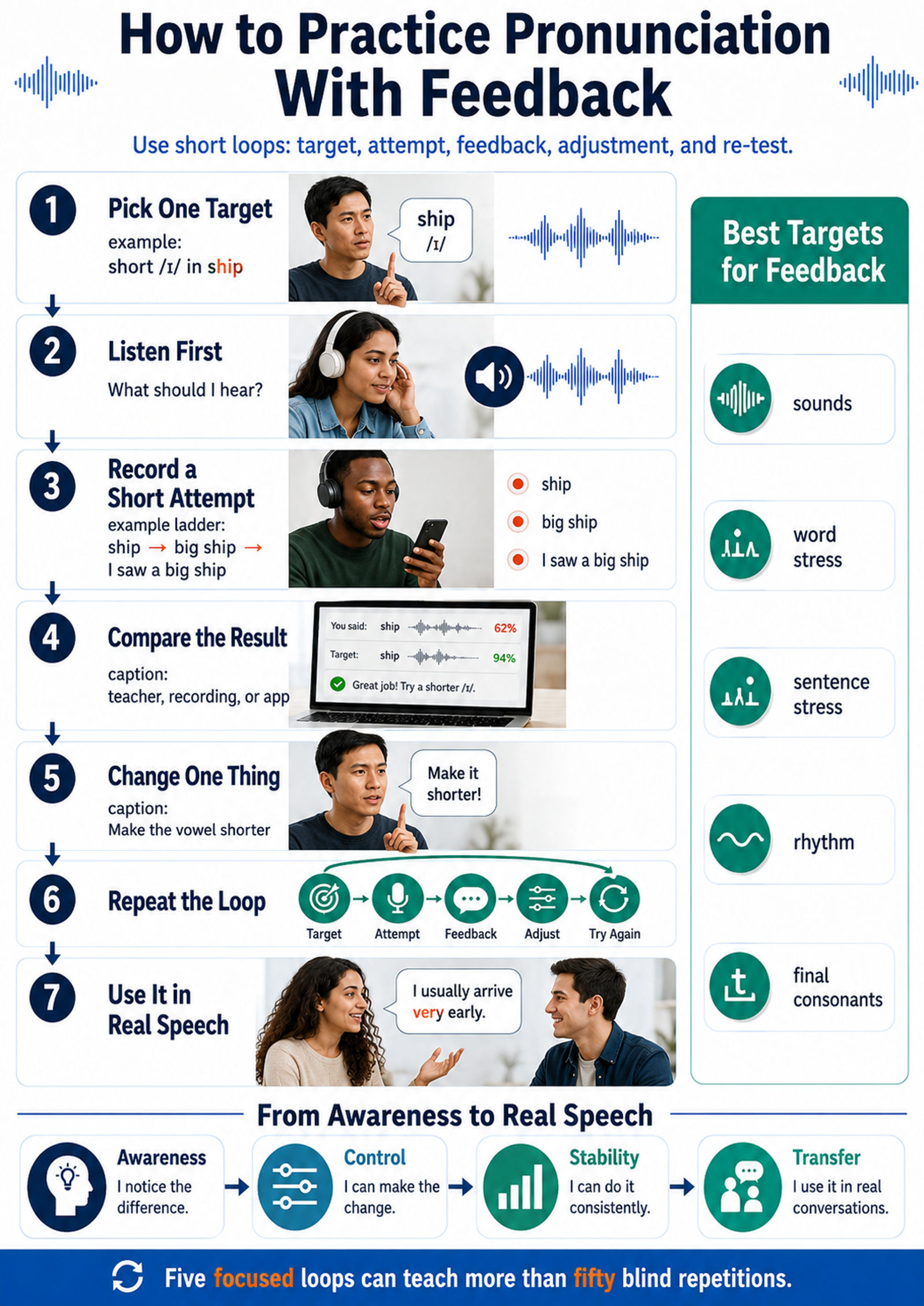
The Feedback Loop Framework
A strong pronunciation feedback loop has six parts.
1. Target
You need a clear model.
The target may come from:
a teacher
a speech coach
a native-speaker recording
a pronunciation app for practicing English by yourself
a minimal pair exercise
a clear audio sample
The target should be small. One sound, one word, or one short sentence works better than a long paragraph.
2. Attempt
You produce the target.
Start short.
For /v/, use “very.” Then use “very good.” Then use “That was very good.”
Short attempts help you control the sound.
3. Signal
You get feedback.
The signal may come from:
a teacher
a trained listener
your own recording
a waveform or visual tool
AI pronunciation feedback, like Syranto
This signal tells you what happened outside your head.
4. Diagnosis
You name the problem.
Examples:
vowel sound
consonant sound
word stress
sentence stress
rhythm
intonation
connected speech
A clear diagnosis keeps practice focused.
5. Adjustment
You change one feature.
One feature matters here.
If you try to fix vowels, consonants, stress, rhythm, and intonation at the same time, your brain gets crowded. A small target gives you more control.
Example:
“Make /ɪ/ shorter in ‘ship.’”
6. Re-test
You say the target again.
Then you check the new version.
Did the sound move closer to the goal? Did the listener hear the right word? Did the stress pattern improve?
This loop creates progress:
Target → attempt → feedback → adjustment → re-test
Common Problems: Why Learners Practice Hard but Stay Stuck
This table summarizes some common problems that English learners face while practicing pronunciation:
Problem | What it looks like | Why feedback helps |
You repeat the same error | The sound feels correct to you | Feedback shows the gap |
You copy spelling | “said” sounds like “sayd” | Feedback points to real sound |
You cannot hear the contrast | “ship” and “sheep” sound alike | Feedback trains the ear |
You lose the sound in sentences | Word practice works, conversation fails | Feedback checks transfer |
You practice too much at once | Every sentence feels difficult | Feedback narrows the target |
You avoid recording yourself | You rely on memory | Feedback gives evidence |
You ignore stress and rhythm | Words sound clear, speech still sounds unnatural | Feedback looks beyond sounds |
You use vague goals | “I want a better accent” | Feedback turns the goal into a task |
What Good Pronunciation Feedback Looks Like
Good pronunciation feedback has five qualities.
1. It is specific
Weak feedback:
“Your pronunciation is wrong.”
Useful feedback:
“Your /v/ sounds like /b/ because both lips close.”
Specific feedback gives the learner a handle. It turns a vague problem into a clear action.
2. It comes soon after the attempt
Feedback works best when the attempt still feels fresh.
If you get feedback three days later, you may forget what your mouth did. If you get feedback right after the word or sentence, you can adjust while the sound remains active in memory.
3. It uses language you understand
A teacher or app with effective pronunciation feedback can use IPA, but the explanation should stay clear.
Good feedback may say:
“The vowel is too long. Make it shorter.”
Then it can add:
“The target sound is /ɪ/, like ‘ship,’ not /iː/, like ‘sheep.’”
The simple instruction comes first. The IPA label supports it.
4. It gives one next step
Too much feedback can block action.
A learner may hear:
“Fix your vowels, final consonants, rhythm, and intonation.”
That may all be true, but it gives the learner too much to carry.
Better feedback says:
“Today, fix final consonants in short sentences.”
Small steps create stronger practice.
5. It tracks change
Good feedback shows progress over time. You can find effective pronunciation feedback from AI-based apps, teachers, or native speakers.
Examples:
“Your final consonants were clear in 7 out of 10 words.”
“Your /r/ sounded clearer this week.”
“Your word stress improved in two-syllable verbs.”
“Your rhythm sounded more natural in short answers.”
Progress tracking matters because pronunciation change can feel slow. Clear evidence helps learners stay motivated.

The Practice Ladder: From Awareness to Real Speech
Pronunciation practice feedback changes as your skill grows.
Stage 1: Awareness
Goal: notice the problem.
Useful feedback sounds like this:
“These two words sound the same right now.”
“The listener heard another word.”
“The stress changed the meaning.”
At this stage, your ear learns what to notice.
Stage 2: Control
Goal: produce the target in short practice.
Useful feedback sounds like this:
“Move your tongue slightly back.”
“Make the vowel shorter.”
“Turn your voice on for /z/.”
“Do not drop the final /k/.”
At this stage, your mouth learns the new movement.
Stage 3: Stability
Goal: keep the sound across words and phrases.
Useful feedback sounds like this:
“Your /v/ works at the start of words, but it weakens at the end.”
“You can say ‘ship,’ but ‘big ship’ still becomes ‘big sheep.’”
“You kept the stress in single words, but lost it in a sentence.”
At this stage, your brain learns consistency.
Stage 4: Transfer
Goal: use the target in real speech.
Useful feedback sounds like this:
“Your /θ/ was clear in practice, but it changed during fast speech.”
“Your rhythm improved in short sentences, but long answers still sound flat.”
“Your final consonants were clearer during slow speech than conversation.”
At this stage, pronunciation moves from exercise to communication.
Where AI Pronunciation Feedback Fits
English learners need many small correction signals. A teacher can help, but most learners practice outside class too.
A pronunciation app like Syranto can give learners more chances to practice, listen, compare, and adjust. It can also help learners focus on specific features instead of guessing what went wrong.
Syranto helps English learners identify weak pronunciation areas, practice targeted sounds and speech patterns, receive feedback, and improve spoken clarity over time. It’s best for focused practice in the long term.
Pick one target. Say the word or sentence. Review the feedback. Adjust one feature. Try again. Keep the work simple and measurable.
Feedback Cannot Replace Practice!
Feedback gives direction. Practice builds control. You need both.
Feedback tells you that “bit” sounds too much like “beat.” Practice helps your mouth produce the shorter vowel again and again. Feedback tells you that final consonants disappear. Practice helps you keep them during real sentences.
Feedback also needs attention. A learner who ignores the signal will repeat the same habit. A learner who studies the signal can make a small change.
Good pronunciation growth usually follows this pattern:
Notice the problem.
Understand the target.
Try a small correction.
Get feedback.
Repeat the correction.
Use it in real speech.
What to Do When You Feel Stuck
If your English pronunciation practice feels stuck, do not add more random repetition. Instead, change the practice system. Ask yourself these questions:
What exact sound or pattern am I practicing?
Can I hear the target clearly?
Can I record my attempt?
Can I get feedback?
Can I change one feature?
Can I test the new version in a sentence?
A broad goal like “I want better pronunciation” can feel too large. A narrow goal like “I want to keep /v/ clear in short sentences” gives your brain a clear job.
The Bottom Line
Pronunciation practice fails without feedback because learners often cannot hear the full gap between target speech and their own speech. Feedback makes that gap visible.
It shows what the listener heard. It points to the sound, stress pattern, rhythm, or mouth movement that needs work. It gives the next attempt a purpose.
That system has three parts: clear sound knowledge, active practice, and feedback.
Syranto can support that process by helping English learners identify weak pronunciation areas, practice targeted sounds and speech patterns, receive feedback, and build clearer spoken English over time.
FAQs About Pronunciation Practice Feedback
Why does pronunciation practice fail without feedback?
Pronunciation practice fails without feedback because you may repeat sounds that feel correct but sound different to listeners. Feedback shows what actually happened, so you can adjust the sound, stress, rhythm, or mouth movement.
Can I improve English pronunciation alone?
You can improve some parts alone, especially listening, recording, and awareness. Your progress usually becomes stronger when you use feedback from a teacher, trained listener, recording tool, or pronunciation app.
Why can’t I hear my own pronunciation mistakes?
Your brain often hears the word you intended to say. Your first language can also filter English sounds, so two English sounds may seem the same until feedback helps you notice the difference.
What kind of feedback helps pronunciation most?
Useful pronunciation feedback is specific, timely, and actionable. It tells you what the listener heard, what caused the problem, and what to change next.
Is pronunciation feedback better than repetition?
Pronunciation feedback and repetition work together. Feedback tells you what to change. Repetition helps the new sound become automatic.
Can AI pronunciation feedback help English learners?
AI pronunciation feedback can help English learners practice more often and focus on specific sounds or speech patterns. It works best when learners choose one clear target, review the feedback, adjust one feature, and try again.
The Syranto app can help design a personalized pronunciation plan to improve your English accent. Check it out now!
Shape your accent, we guide the way.
Reading helps you understand. Practice helps you change how you sound.
Start practicing →