
 Get Android
The Role of Auditory Feedback in Accent Learning: Your Ear is the Control Room
What is the auditory feedback loop, and how does it kick-start improvement for your English accent? Let's look at the definitions and methods that will help you make the most of the auditory feedback loop.
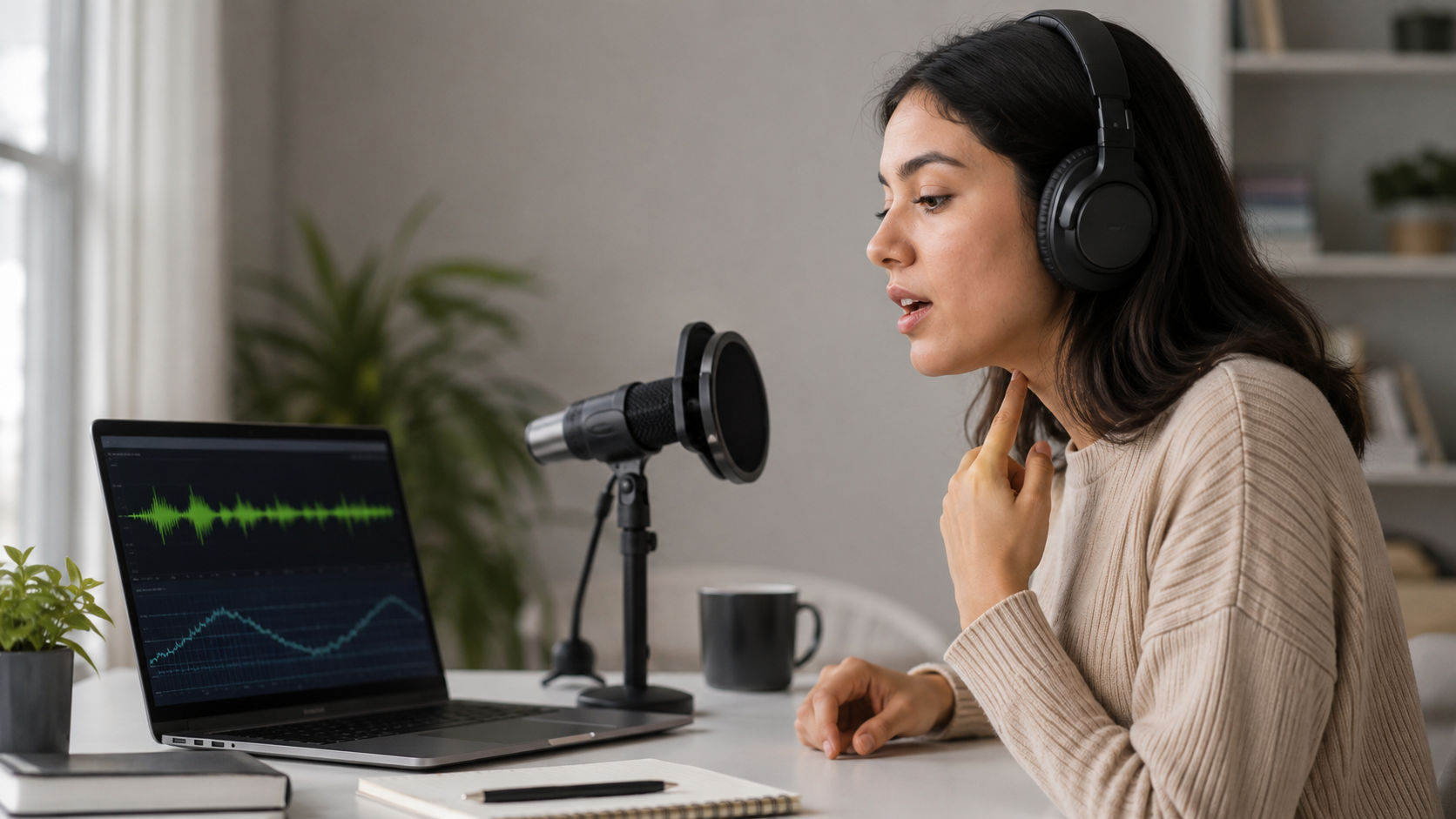
Many English learners treat pronunciation like a mouth problem. They ask, “Where does my tongue go?” or “How do I move my lips?” Those questions matter, but your mouth cannot aim well if your ear gives it a blurry target.
Auditory feedback is the sound information you hear while you speak. It tells your brain what happened after your mouth moved. Then your brain compares that sound with the English target and decides what to change next. It's a key component for improving your English pronunciation and accent!
How Does Auditory Feedback Help English Pronunciation?
Auditory feedback helps accent learning because your brain uses what you hear to guide speech movement. When you hear the difference between your pronunciation and a target sound, you can adjust your tongue, lips, voice, rhythm, and timing. Accent learning works best when you combine focused listening, active speaking, and repeated feedback.
The Accent Learning Control Room
Think of accent learning as a control room with four screens:
One screen shows what you want to say.
The next screen shows how English should sound.
The third screen tracks what your mouth does.
The last screen plays back what actually came out.
Auditory feedback lives on that fourth screen.
If that screen stays dark, you may practice for months without knowing what changed. You may repeat “think” many times, but your brain may still accept “tink” or “sink” as close enough. Feedback lights up the screen. It says, “That sound matched,” or “That sound missed the target.”

Pronunciation practice needs more than repetition: Repetition gives your mouth exercise, but feedback gives your brain direction.
Why Your Ear Leads Your Mouth
Speech starts with a sound goal.
Before you say “ship,” your brain has a rough sound plan for /ʃɪp/. That plan includes the /ʃ/ sound, the short vowel /ɪ/, and the final /p/. Your mouth then tries to create that plan.
The problem comes when the sound goal feels unclear. If “ship” and “sheep” sound almost the same to you, your brain may send your mouth toward the wrong vowel. You might know the spelling difference, but spelling does not train the ear.
Your ear needs to build sharper categories:
English Contrast | What the Ear Must Notice | Why It Affects Speech |
|---|---|---|
“ship” /ʃɪp/ vs. “sheep” /ʃiːp/ | Short relaxed vowel vs. long tense vowel | The mouth needs different tongue tension and length |
“light” /laɪt/ vs. “right” /raɪt/ | Clear /l/ vs. darker /r/ | The tongue makes different shapes |
“thin” /θɪn/ vs. “tin” /tɪn/ | Airy dental sound vs. stopped /t/ | The tongue and airflow must change |
“cap” /kæp/ vs. “cab” /kæb/ | Final voiceless vs. voiced consonant | The vowel and final sound timing change |
When the ear hears the contrast, the mouth gets a better map.
The Feedback Gap: Why You Sound Different to Yourself
Your own voice tricks you a little.
When you speak, you hear your voice through air and through vibration inside your head. Other people hear mainly the sound that travels through air.
That is why recordings can feel strange. A recording removes much of the internal vibration and gives you a clearer version of what listeners hear.
For instance, you may think your /v/ sounds strong because you feel vibration. But a recording may show that the sound came out closer to /b/ or /w/.
You may think your sentence stress sounds natural because the rhythm feels clear in your head. But the listener may hear equal stress on every word. Recordings make auditory feedback more honest.
The Three Jobs of Auditory Feedback
Auditory feedback has three jobs in accent learning.
1. It Finds the Gap
Feedback helps you hear the distance between your sound and the target.
For example, you say “very,” but it sounds like “wery.” The gap is lip-teeth contact and friction. Your upper teeth need to touch your lower lip lightly, and your voice needs to vibrate.
Once you hear the gap, the sound becomes easier to train.
2. It Guides the Repair
Feedback tells you what to adjust.
If your /θ/ sounds like /s/, your tongue may sit behind the teeth. If your /θ/ sounds like /t/, you may stop the air too strongly. Both errors affect “think,” but each one needs a different repair.
Good feedback gives a precise instruction, not a vague judgment.
3. It Builds a New Habit
Accent change needs many small updates.
The first correct attempt may feel slow and strange. That is normal. Your brain needs repeated feedback before the new sound becomes automatic. Each accurate attempt strengthens the link between the sound goal, the mouth movement, and the sound result.
That is how a practiced sound becomes a speech habit.
Why “Listen and Repeat” Often Fails
“Listen and repeat” can help, but only when the learner knows what to listen for.
A learner may hear a model sentence and repeat it five times. The rhythm may stay flat. The vowel may stay too long. The final consonant may disappear. The learner worked hard, but the feedback stayed vague.
A stronger version looks like this:
Listen for one feature.
Say the word or sentence.
Record yourself.
Compare that one feature.
Change one movement.
Try again.
The target must be small. Your brain cannot fix every sound, stress pattern, and rhythm problem at once.
Common Problems Learners Miss Without Feedback
Pronunciation errors often hide inside familiar words. You may know the word, read it easily, and use it often. That can make the pronunciation error harder to notice.
Common feedback problems include:
You hear the word meaning, but miss the sound detail.
You notice a mistake in another learner’s speech, but miss it on your own.
You feel the correct mouth movement, but the sound still does not match.
You pronounce a sound correctly alone, then lose it in sentences.
You hear that something is “off,” but cannot name the feature.
You repeat the same word too fast and train the old habit again.
The solution is slow, narrow practice. Work on one sound feature, one word, or one short sentence. Then widen the practice after the target becomes clearer.
Auditory Feedback for Individual Sounds
Auditory feedback works well for sound contrasts.
Take /b/ and /v/. Many learners can describe the difference but still mix them in speech. /b/ stops the air. /v/ lets air pass with voice and friction.
Try this:
“berry” / “very”
Listen, then record both words. Then ask one question: Did “very” have continuous sound, or did it start with a full stop?
That single question sharpens your listening. It also points to the mouth movement you need.
The same method works with:
/r/ and /l/: “right” vs. “light”
/s/ and /z/: “sip” vs. “zip”
/ɪ/ and /iː/: “ship” vs. “sheep”
/p/ and /b/: “pat” vs. “bat”
/θ/ and /t/: “thin” vs. “tin”
Listen carefully! Each pair trains your ear to hear the contrast before your mouth tries to control it.
Auditory Feedback for Rhythm and Stress
Accent learning also includes rhythm, word stress, and sentence stress in English.
English uses strong and weak beats. Important words often receive more stress. Small grammar words often reduce. That is why “I can go” may sound different from “I can’t go,” even when the words move quickly.
Auditory feedback helps you hear:
which syllable receives stress
which words sound weaker
where pitch rises or falls
where the sentence feels too flat or too choppy
The Fast Loop and the Slow Loop
Accent learning uses two feedback loops; this is true for both in-person accent training and for effective computer-based accent training.
The fast loop happens while you speak. You hear your sound and make small adjustments in real time. This helps with volume, pitch, speed, and familiar sounds.
The slow loop happens after you speak. You listen to a recording, compare it with a model, and plan your next attempt. This helps with harder accent features because you have more time to notice details.
Live speaking builds fluency. Recorded feedback builds accuracy. A smart practice routine uses both.
Your Daily 12-Minute Auditory Feedback Practice Routine
Use this routine when you want sharper pronunciation practice.
Minute 1: Pick One Target
Choose one feature. Good targets include /v/, /θ/, final consonants, word stress, or rising intonation.
Minutes 2–3: Train the Ear First
Listen to three to five examples. Do not speak yet. Ask, “What feature makes this sound different?”
Minutes 4–5: Try One Word
Say one word slowly. Record it. Compare your version with the model.
Minutes 6–7: Make One Change
Change one movement. Move the lip, tongue, jaw, airflow, voice, stress, or pitch. Avoid full-sentence practice until the feature improves.
Minutes 8–9: Add a Sentence
Use the target in one short sentence. Keep the sentence natural and slow.
Minutes 10–11: Compare First and Last Attempts
Play your first recording and final recording. Determine what has improved.
Use simple notes:
“Final /v/ is clearer.”
“Stress still sounds flat.”
“/θ/ improves when I slow down.”
Minute 12: Repeat Once Without Looking
Say the sentence again from memory. This helps move the target from practice into speech.
What Good Feedback Sounds Like
Good feedback should be specific, usable, and tied to a sound feature.
Weak Feedback | Better Feedback |
|---|---|
“Your accent is strong.” | “Your final consonants often disappear.” |
“Say it again.” | “Release the /t/ softly at the end of ‘right.’” |
“Be clearer.” | “Lengthen /iː/ in ‘sheep’ and relax /ɪ/ in ‘ship.’” |
“Your rhythm is wrong.” | “Stress the content words: ‘I NEED to GO.’” |
“That sounds unnatural.” | “Reduce ‘to’ in ‘want to’ so the phrase flows.” |
Useful auditory feedback for accent training gives your ear a target and your mouth a task.
Why Adults Can Still Improve
Adult learners can improve pronunciation. Age can affect accent learning, but it does not close the door.
Adults often need more explicit feedback because their first-language sound system already feels automatic. The brain may sort English sounds through old categories. For example, a learner may hear English /ɪ/ through the closest vowel category in their native language.
Focused auditory feedback helps the brain build new categories. The change may feel slow at first, but small gains compound. A learner who hears one contrast more clearly can practice it more accurately. Accurate practice then gives the brain better feedback again.
That is the engine of accent progress.
The Best Feedback Mix
Use three kinds of feedback.
Self-feedback helps you notice your own patterns. Recording yourself builds independence.
Human feedback helps with meaning, naturalness, and communication. A teacher can explain what changed and why it matters.
App feedback helps with repetition and focus. Syranto can help you practice specific pronunciation targets across many attempts.
Each type sees something different. Together, they give a fuller picture.
Key Takeaway
Auditory feedback turns pronunciation practice from guessing into guided training.
Your ear builds the target. Your mouth tests the target. Your brain compares the result. Then the next attempt gets sharper.
Accent learning improves when you stop asking only, “How do I move my mouth?” and start asking, “What did I hear, and what should I change?”
That question makes your ear the control room.
Syranto can identify where you need improvement. It's the ultimate tool for auditory feedback and accent training, right in your pocket!
Shape your accent, we guide the way.
Reading helps you understand. Practice helps you change how you sound.
Start practicing →