
 Get Android
English Intonation Patterns: How Pitch Changes Meaning
Intonation gives English its flow. It rises and falls, like a swing. Following the correct intonation patterns brings clarity and nuance to your English speaking. Let's learn how it works and how to make you English speaking really flow!

English intonation patterns explain how your voice rises and falls when you speak. They help listeners understand your meaning, attitude, and sentence type. The same words can sound final, open, polite, surprised, doubtful, or even unfinished because of pitch.
Many English learners focus on consonants and vowels first. That makes sense. Clear sounds matter! Yet intonation gives English its movement. Without it, speech can sound flat, too strong, or unclear, even when every word is technically pronounced correctly.
Research about English prosody—the combination of intonation, stress, and rhythm—plays a major role in how understandable a speaker sounds. In many cases, listeners can understand imperfect consonants and vowels more easily than speech with unnatural stress and intonation patterns.
Quick Answer: What Are English Intonation Patterns?
English intonation patterns are pitch movements across a phrase or sentence. The three most useful patterns are falling intonation, rising intonation, and fall-rise intonation. Falling intonation often sounds complete. Rising intonation often sounds open or questioning. Fall-rise intonation often adds contrast, politeness, hesitation, or implied meaning.
Linguists describe intonation as a system that helps speakers organize information and express attitudes. Rather than being decorative, pitch movement carries meaning that listeners process automatically during conversation.
Why English Intonation Matters for Learners
Intonation helps listeners follow your message faster. It shows where one thought ends, what information matters most, and how you feel about the words you say.
Take this one-word sentence:
“Really?”
With rising intonation, it can sound like a real question. With falling intonation, it can sound like disbelief. With fall-rise intonation, it can sound careful, polite, or mildly doubtful.
English speakers use pitch as part of meaning. Your words carry the message, but your pitch shapes the listener’s reaction.
Studies on second-language speech suggest that listeners often judge fluency and confidence partly through prosodic features. Even when grammar is accurate, unusual intonation patterns can make speech seem hesitant, overly direct, or difficult to follow.
The Science Behind Intonation and Meaning
Intonation is closely connected to how the brain processes spoken language. When listeners hear speech, they do not rely only on words. They also use pitch patterns to predict whether a speaker is asking a question, finishing a thought, introducing new information, or expressing emotion.
Researchers have found that intonation helps listeners:
Identify sentence boundaries.
Recognize important information.
Interpret speaker attitudes.
Follow conversational turn-taking.
Understand implied meanings.
This explains why learners sometimes feel misunderstood even when they use correct vocabulary. The words may be accurate, but the pitch pattern may send a different message.
Falling Intonation: The Voice Moves Down
Falling intonation means your pitch drops on the final stressed word or syllable. English speakers often use it for finished thoughts, statements, commands, and many “wh-” questions.
Examples:
“I live in Chicago.”
“Close the door.”
“Where are you going?”
“That sounds good.”
The voice usually drops on the key word: “Chicago,” “door,” “going,” or “good.” This fall tells the listener that the idea feels complete.
Learners often miss this final drop. The sentence may sound unfinished, even when the grammar is correct. A clear fall gives your speech more confidence and structure.
Research on conversational English shows that falling intonation frequently signals completion. It helps listeners recognize that a speaker has finished a thought and may be ready for a response.
Rising Intonation: The Voice Moves Up
Rising intonation means your pitch rises at the end of a phrase. English speakers often use it for yes/no questions, checking information, lists that continue, and friendly signals that show the conversation can keep moving.
Examples:
“Are you ready?”
“Did you call Sarah?”
“You wanted coffee?”
“I bought apples, bread, and cheese.”
In the list example, “apples” and “bread” can rise because the list continues. “Cheese” usually falls because the list ends.
Rising intonation also helps with confirmation. “You’re from Brazil?” sounds like the speaker wants to check information. A fall in the same sentence can sound more certain.
In conversation analysis research, rising pitch is often associated with openness and interaction. It can encourage the other speaker to respond, confirm information, or continue the discussion.
Fall-Rise Intonation: The Voice Drops, Then Lifts
Fall-rise intonation starts with a small fall and ends with a small rise. This pattern often adds meaning beyond the words. It can show politeness, contrast, uncertainty, or a hidden “but.”
Examples:
“It’s nice.”
Meaning: It is nice, but maybe I have another thought.“I can come.”
Meaning: I can come, but there may be a condition.“That’s interesting.”
Meaning: I am thinking carefully, or I may have a concern.
This pattern helps English speakers sound more flexible. It softens strong statements and gives the listener space to respond. Many learners use a simple fall here, which can make a careful comment sound final or blunt.
Linguists often describe fall-rise intonation as one of the most meaning-rich patterns in English because it frequently communicates information that is implied rather than directly stated.
How Native Language Influences English Intonation
Every language uses pitch differently. Some languages rely heavily on pitch for word meaning, while others use it mainly for sentence-level communication.
As a result, learners often transfer intonation habits from their first language into English. This process is known as “language transfer.”
For example:
Speakers of some languages may use a narrower pitch range, making English sound flat.
Speakers of other languages may use stronger rises, causing statements to sound like questions.
Some learners place pitch movement on different parts of the sentence than native English speakers typically do.
Understanding this influence can reduce frustration. Intonation difficulties are not usually caused by a lack of effort. They are often the result of fossilized English speech habits.
Common Problems with English Intonation
English learners often face these problems:
Flat pitch: the voice stays at one level, so speech sounds robotic or tired.
Rising pitch too often: every sentence sounds like a question.
Falling pitch too strongly: statements sound too direct or cold.
Wrong focus word: the pitch moves on a small grammar word instead of the main meaning word.
Native language transfer: learners carry pitch habits from their first language into English.
The biggest problem is usually awareness. Many learners can hear word mistakes, but they cannot hear pitch mistakes yet. Intonation practice trains the ear first, then the voice.
Research on pronunciation training suggests that perception often develops before production. In simple terms, learners usually need to hear intonation differences clearly before they can improve English intonation.
How Sentence Stress Changes Intonation
Intonation works closely with English sentence stress patterns. The main pitch movement often lands on the most important word.
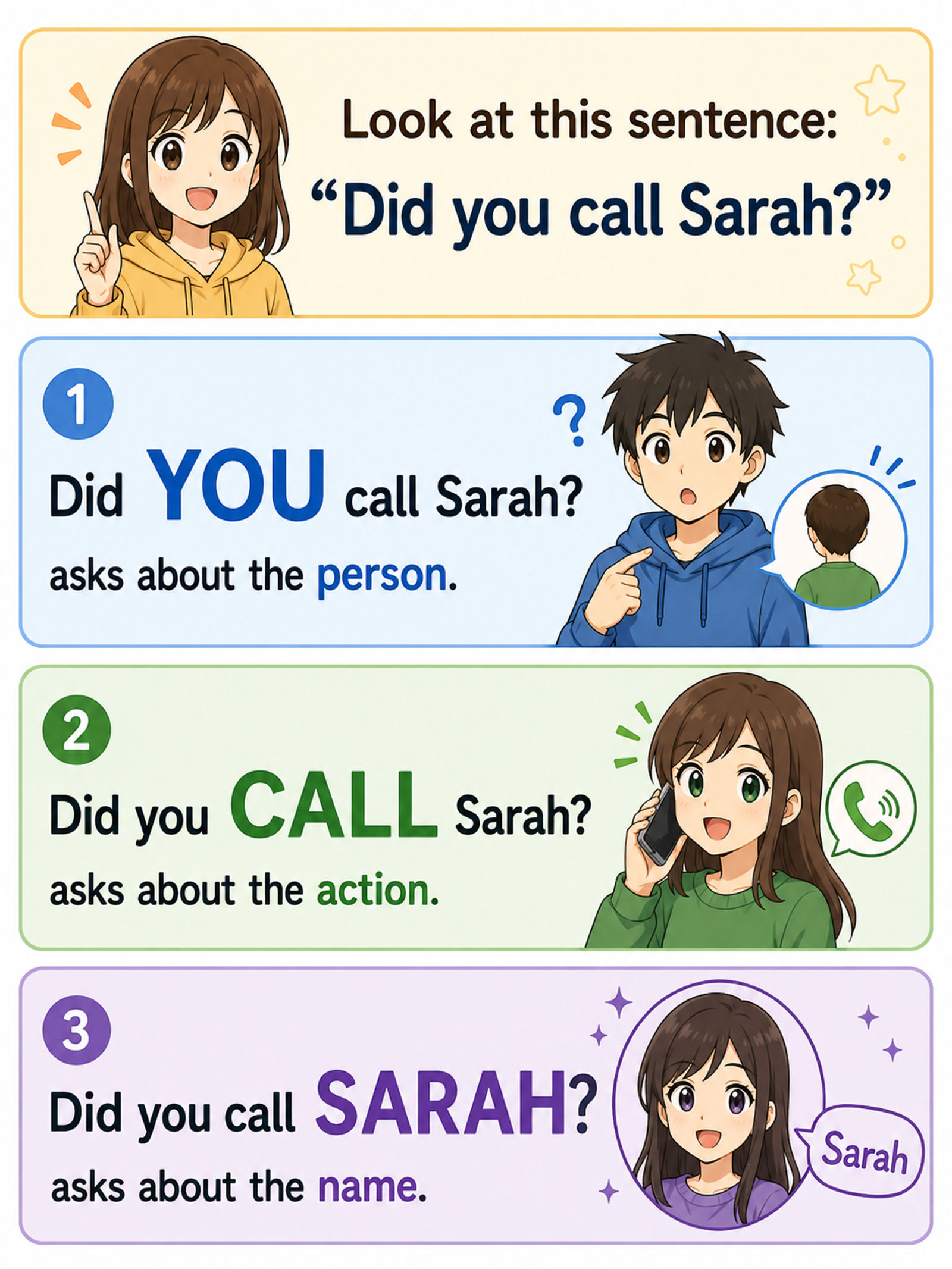
Researchers refer to this as information focus. Speakers naturally highlight information that is new, important, surprising, or contrasted with another idea. Listeners use these cues to understand what matters most in a message.
How to Practice English Intonation Patterns
Choose one short sentence. Start with “I can help you today.”
Mark the focus word. Say “I can HELP you today,” then “I can help YOU today.”
Add arrows. Use ↓ for falling pitch, ↑ for rising pitch, and ↓↑ for fall-rise pitch.
Record yourself. Listen for the pitch movement, not the individual sounds.
Compare three versions. Say the sentence as a statement, a question, and a careful response.
Practice with real speech. Use short clips from podcasts, interviews, or lessons. Copy the melody, pauses, and focus words.
Get feedback. The Syranto app can help you identify weak pronunciation areas, practice targeted patterns, and build clearer speech with repeated feedback.
FAQs About English Intonation Patterns
What are the main English intonation patterns?
The main English intonation patterns are falling intonation, rising intonation, and fall-rise intonation. Some speakers also use rise-fall patterns for strong emotion, surprise, or emphasis.
Why does my English sound flat?
Your English may sound flat if your pitch stays at one level. Practice short sentences with clear rises and falls. Focus on the main word in each sentence. A limited pitch range is one of the most common prosodic challenges for English learners.
Does intonation change meaning?
Yes. Intonation can change a statement into a question, show contrast, soften a comment, or signal that a thought has more meaning behind it. Research shows that listeners often interpret attitude and intention through pitch patterns before they fully process the words themselves.
Can I practice intonation alone?
Yes. Record short sentences, mark pitch arrows, copy native speaker clips, and compare your voice with the model. Feedback makes the process faster because it helps you hear patterns you may miss alone.
Try the Syranto app to get immediate and targeted feedback about pronunciation and intonation. Your English accent will thank you!
Shape your accent, we guide the way.
Reading helps you understand. Practice helps you change how you sound.
Start practicing →