Get Android
Visual Pronunciation Feedback: What Can AI Show You?
Here's the science behind targeted AI pronunciation feedback -- along with visual cues in the feedback -- and how it helps you improve your English accent effectively and efficiently.
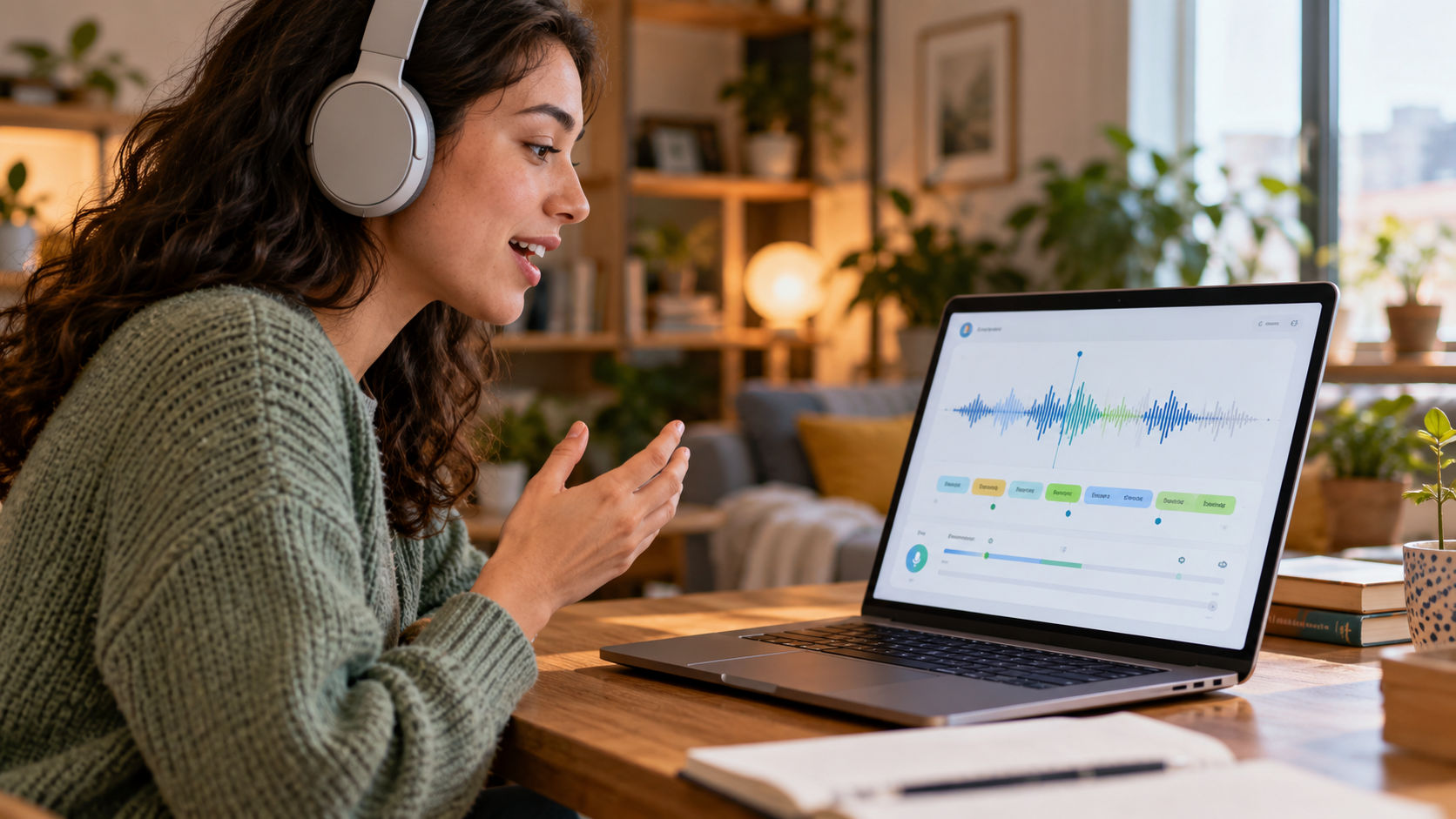
You record a sentence. A word changes color. A line shows where you paused. Now you have something to look at, but what should you change when you speak again? That is the practical question behind visual pronunciation feedback.
Visual pronunciation feedback can raise a useful question: what happened in that recording? A short explanation can help you choose your next action. For English learners, the important step is turning the information on the screen into a clear practice goal.
Quick Answer
Visual pronunciation feedback presents information about your speech through features such as highlighting or timing displays. Written pronunciation feedback explains what a result means and suggests a change. When choosing AI pronunciation feedback, look for a specific target you can understand, try, and check in your next recording. A score alone leaves that decision to you.
Why This Matters for English Learners
English pronunciation involves individual sounds and the way words fit together. You might say every word clearly but place a pause where it separates closely related ideas. You might also give equal emphasis to words that carry different amounts of information.
Consider this sentence:
I ordered the BLUE notebook.
The emphasis suggests that the color matters. Perhaps someone brought you a red notebook. Now move the emphasis:
I ordered the blue notebook.
The sentence now draws attention to the person who placed the order. These are original teaching examples, not sentences taken from the experiment below.
English sentence stress gives you a practical target for accent training. You can decide which word should stand out, record the sentence, and ask whether a listener heard the intended emphasis. Our guide to sentence stress and meaning explores this further.
What Did the Researchers Test?
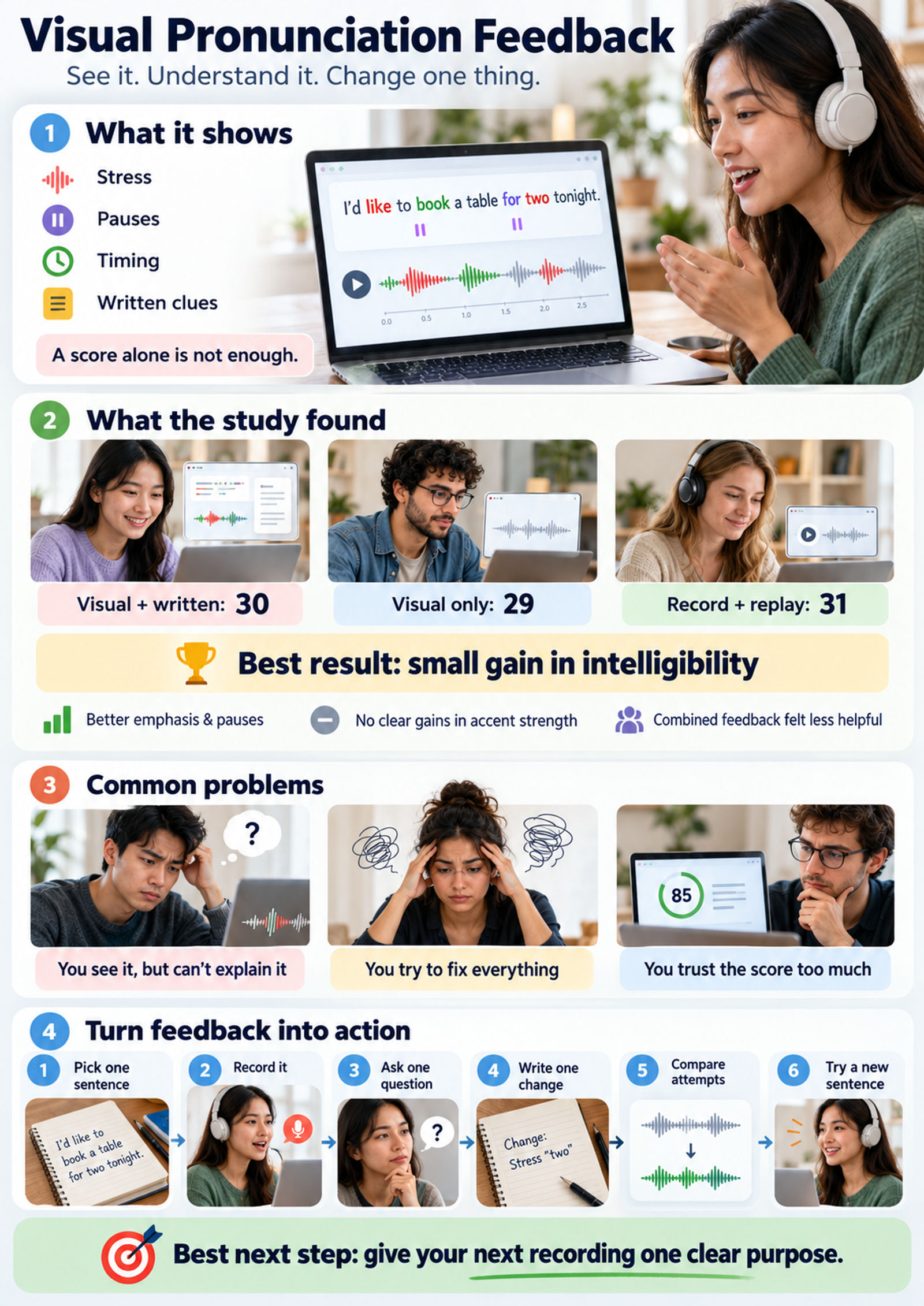
Hirschi and colleagues’ 2025 study analyzed 90 of 136 starters from North American English courses. Ages ranged from 18 to 60+, averaging 25.4; proficiency was self-reported B1+. First languages varied.
Their custom system combined Whisper, Wav2vec 2.0, prosody analysis and fine-tuned GPT-3.5 Turbo explanations.
Condition | Learners |
|---|---|
Visual plus written feedback | 30 |
Visual feedback | 29 |
Recording and replay | 31 |
How Did the Experiment Work?
Assign learners pseudorandomly and record scripted and spontaneous pretests.
Deliver four lessons on emphasis, pauses, pace and sounds, with condition-specific practice.
Collect posttests and helpfulness ratings; average pre/post interval: 4.3 days.
Use trained human raters and mixed-effects analyses to assess changes.
What Did the Results Show?
Outcome | Reported Finding |
|---|---|
Intelligibility | Combined-feedback time interaction: p=.019; within-group improvement: p=.004, small effect, magnitude d=.23 |
Emphasis and pauses | Combined feedback supported emphasis and scripted pause grouping |
Sound accuracy, comprehensibility, accentedness | No significant improvement |
Helpfulness | Combined feedback received lower ratings |
What Can This Study Tell Us?
The authors favor combined feedback, cautiously: post-hoc between-group comparisons were nonsignificant. Attrition, brief exposure, unequal practice opportunities and rehearsed test material limit conclusions about lasting, spontaneous-speaking benefits. Check out the methods and results for more details.
What Does “Clearer Speech” Mean?
Three terms can help you read pronunciation research and choose a goal for your own recordings:
Intelligibility: how much of your speech a listener understands.
Comprehensibility: how easy or difficult your speech feels to understand.
Accentedness: how strongly a listener hears an accent that differs from their reference accent.
These questions describe different aspects of English pronunciation. Someone can understand your message and still notice your accent. A listener might also understand every word while needing extra effort to follow the sentence.
For a practical speech intelligibility check, ask someone to write down the words they heard. For an ease-of-understanding check, ask which part required a second listen. These informal checks serve different purposes; neither produces an official test score.
If your goal is to improve your English accent, define the next change clearly. “Make the contrast between these two words audible” gives you a more specific task than “sound better.”
Common Problems With Visual Pronunciation Feedback
You notice the result but cannot explain it
Visual pronunciation feedback gives you somewhere to focus. A highlighted word can become the starting point for targeted English pronunciation work. Before repeating it, identify the question you need answered: is the issue a vowel, a consonant, emphasis, or timing?
Look for an explanation or an audio model. If the display remains unclear, ask a teacher to help interpret it. Guessing what a color means gives your pronunciation practice an uncertain target.
You try to change everything at once
Imagine receiving comments about a vowel, two pauses and several stressed words. Choose one feature for the next attempt. Keep the other comments in a short pronunciation practice log.
This is a suggested way to organize your work, not a claim that one correction per attempt is always the most effective method.
You judge progress only by the app score
Keep the recording as well as the number. Listen for the feature you intended to change, and check it with another person when possible. AI pronunciation feedback gives you information to investigate; a score does not explain every aspect of the listener’s experience.
Our guide to self-monitoring and real-time feedback offers another way to think about checking your own speech.
How to Practice: Turn Feedback Into One Clear Action
The following routine is an original practice suggestion inspired by the topic. It does not reproduce the researchers’ intervention, and its timing has not been tested in that study.
1. Choose a sentence for pronunciation practice
For this English sentence stress exercise, start with something short:
Please send the revised file before Friday.
Decide what you want the listener to notice. Is the important information the revised version or the deadline? Write that intention beside the sentence.
2. Record your first attempt
Use a quiet space and keep a comfortable speaking pace. Save the recording so you can compare it with your next attempt. For a fuller routine, try these sentence recording exercises.
3. Turn visual pronunciation feedback into a question
If a tool displays emphasis or pauses, inspect the part relevant to your goal. Ask, “Did the deadline stand out?” or “Did I split the phrase ‘revised file’?” Use only the information the tool actually provides. If your AI pronunciation feedback covers sounds alone, choose a sound target instead.
4. Write one instruction for the next recording
For example: “Make Friday stand out while keeping the rest of the sentence comfortable.”
Written pronunciation feedback is useful to you when you can translate it into an action. If an instruction contains unfamiliar terms, get those terms explained before you try again.
5. Compare the two attempts
Listen without watching the score. Can you hear the intended change? If someone is available, ask which word sounds most important without telling them your answer first.
6. Try the same goal in a new sentence
Create another request with a different deadline. Check whether you can keep the emphasis clear without copying the first recording. This gives you a separate practice task; it does not establish long-term learning by itself.
Repeat this pronunciation practice routine with a new target when you are ready. Keep your accent training goal visible beside the recording. The pronunciation feedback loop provides a broader framework for organizing this kind of accent training.
Add a Model to Your English Pronunciation Practice
Syranto’s Vocalize feature lets you enter text and hear it spoken, with British and American voice options. You can use it to listen to a model of a sentence you want to practice.
Listen, record your own attempt with a recording tool, and choose one feature to compare. Syranto supplies the model in this routine; the research above tested a separate custom feedback system.
Start with a sentence you expect to use today. Give your next recording one clear purpose.
Frequently Asked Questions
What should visual pronunciation feedback help me understand?
It should make a feature of your recording easier to inspect. Check the tool’s explanation of its colors, symbols or timing marks so you know what the display represents.
What should I do if written feedback is confusing?
Ask for a simpler explanation and an example. Turn the comment into a specific instruction you can try, such as keeping a final consonant audible or placing a pause between complete ideas.
Can I work on English pronunciation without an AI tool?
You can use a model recording, record yourself, and ask a teacher or partner for feedback. Choose a clear target and keep both attempts for comparison. AI is one possible source of feedback within that process.
How can I check speech intelligibility during practice?
Ask a listener to repeat or write down what they heard before showing them your script. Note any misunderstood words. Use this as an informal check to guide pronunciation practice, rather than a standardized assessment.
Reference
Hirschi, K., Kang, O., Yang, M., Hansen, J. H. L., & Beloin, K. (2025). Artificial Intelligence-Generated Feedback for Second Language Intelligibility: An Exploratory Intervention Study on Effects and Perceptions. Language Learning, 75(S1), 204–241. https://doi.org/10.1111/lang.12719
Syranto offers research-backed methods to help you get a more natural and native-sounding English accent. Get started today!
Shape your accent, we guide the way.
Reading helps you understand. Practice helps you change how you sound.
Start practicing →