
 Get Android
Sentence Stress in English: How Stress Changes Meaning
Sentence stress in English can change the meaning of a sentence. You can use the same words, the same grammar, and the same word order. But if you stress a different word, your meaning can change.

Sentence stress in English matters, because how you emphasize different words within the sentence can change the meaning of the whole sentence.
It helps your listener understand your real message. For English learners, sentence stress can feel difficult because it does not always appear in writing. You need to hear it, feel it, and practice it aloud.
What Is Sentence Stress in English?
Sentence stress means you make some words stronger than others when you speak.
A stressed word usually sounds louder, longer, clearer, and either higher or lower in pitch. The stressed word automatically sounds more important than other words in the sentence.
In English, sentence stress helps show the focus of your message. Pronunciation experts often call this prominence. Prominence means one word or syllable stands out in speech. It uses stress, pitch, length, and voice energy to show meaning.
Here’s a quick example before we dive into the mechanics of word stress and sentence meaning:
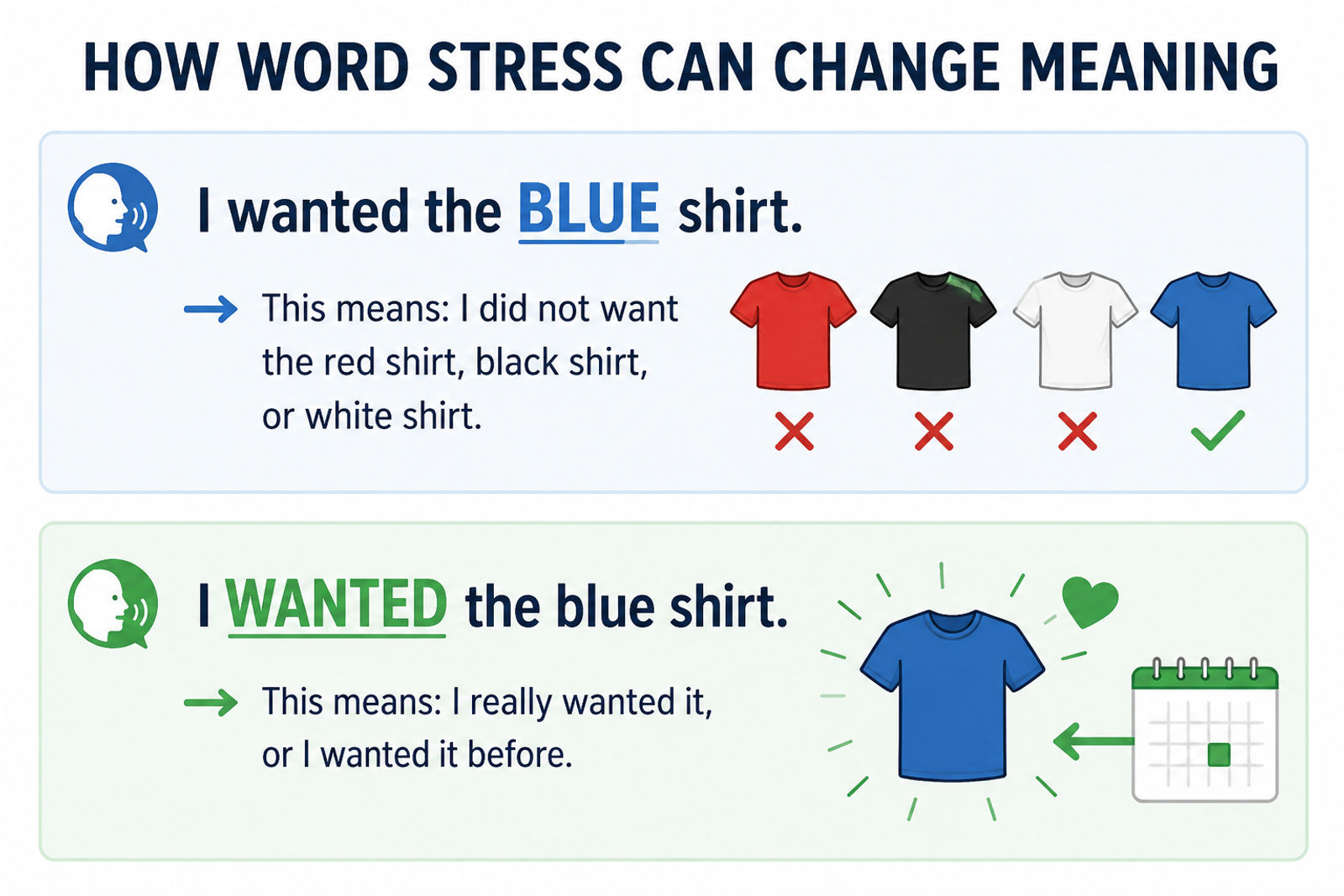
Quick Answer: How Does Sentence Stress Change Meaning?
Sentence stress changes meaning because it tells the listener which word matters most.
Look at this sentence:
I didn’t say he stole the money.
What happens when you change the word stress throughout the sentence?
Stressed Word | Meaning |
|---|---|
I didn’t say he stole the money. | Someone else said it. |
I didn’t say he stole the money. | I deny saying it. |
I didn’t say he stole the money. | I suggested it, wrote it, or implied it. |
I didn’t say he stole the money. | Someone else stole it. |
I didn’t say he stole the money. | Maybe he borrowed it or found it. |
I didn’t say he stole the money. | He stole something else. |
The words stay the same, but the meaning changes because the stress changes.
This is called contrastive stress. You use contrastive stress when you compare, correct, deny, or clarify something.
Why Sentence Stress Matters for English Learners
Many English learners focus on single sounds first. You need clear vowels and consonants.
But a natural English accent also depends on rhythm, stress, and intonation. These features help listeners understand which words matter most.
If you stress the wrong word, your sentence may sound flat, unclear, or too strong. It can be hard for a native speaker to follow your meaning, and you may express something different from your intended meaning.
Of course, this does not mean your English is “bad.” It means your speech needs focused training.
Tip: Content Words Usually Get More Stress
In normal English sentence stress, speakers often stress content words.
Content words carry the main information.
These include:
Nouns: teacher, problem, phone
Main verbs: buy, need, forgot
Adjectives: new, difficult, late
Adverbs: quickly, clearly, yesterday
Negative words: not, never, no
Example:
I need a NEW phone.
The words need, new, and phone carry the main meaning.
Small grammar words often sound weaker.
These include:
Articles: a, the
Prepositions: to, for, at
Helping verbs: do, have, can
Pronouns: he, she, it
Conjunctions: and, but, or
Example:
I need a new phone.
In natural speech, a may sound very weak:
I need uh NEW phone.
This weak sound is normal in English.
…But Any Word Can Be Stressed
The content-word rule helps, but it is not enough. In real speech, you can stress almost any word when you want to change the meaning.
Look at this example sentence:

Sentence stress is not only about grammar. It is also about meaning.
Sentence Stress vs. Word Stress
Do not confuse sentence stress with English word stress!
Word stress happens inside one word.
Example:
PREsent = noun
preSENT = verb
Sentence stress happens across a full sentence.
Example:
I bought a PRESENT.
I bought a present for YOU.
I BOUGHT a present. I didn’t make one.
Word stress helps people understand a single word, while sentence stress helps people understand your message.
Sentence Stress and English Rhythm
English has a strong rhythm. Important words often get more time. Less important words become shorter and weaker.
I’m going to call you later.
Natural rhythm may sound like:
I’m gonna CALL you LATER.
The stressed words are clearer: “call” and “later.”
The smaller words become weaker: “I’m gonna” and “you.”
In English, clear speech does not mean every word has equal strength. Clear speech means the right words stand out.
How Sentence Stress Changes Emotion
Sentence stress can also change emotion.
Look at this example:

Stress works with intonation, or the rise and fall of your voice. Together, stress and intonation help show attitude, emotion, and even sarcasm.
Common Sentence Stress Problems for English Learners
Many learners know English grammar well but still sound unclear. Sentence stress may cause part of the problem.
Here are common issues.
1. Stressing Every Word Equally
Some learners pronounce every word with the same force.
I / want / to / improve / my / English / pronunciation.
This can sound robotic.
More natural:
I want to imPROVE my English pronunciATION.
The key words carry more weight.
2. Stressing Grammar Words Too Much
A learner may say:
I WANT TO GO TO THE STORE.
This gives too much stress to “to” and “the.”
To sound more natural, say:
I WANT to GO to the STORE.
Make the important words stand out.
3. Missing Contrastive Stress
A learner may use normal sentence stress when they need to correct someone.
A: “You said Anna broke the laptop.”
B: “I didn’t say Anna broke the laptop.”
That response may sound unclear. Try this instead:
I didn’t say ANNA broke the laptop.
Meaning: Someone else broke it.
Or:
I didn’t SAY Anna broke the laptop.
Meaning: I did not say it directly.
4. Using Pitch Without Enough Length
Some learners raise their pitch but do not make the stressed word longer or clearer.
In English, stress often uses several signals at once, including pitch movement, longer vowel, clearer pronunciation, and stronger voice energy.
Make the stressed word stand out in several ways.
How to Hear Sentence Stress
Before you can produce sentence stress well, you need to hear it.
Try this simple listening method.
Choose one short sentence from a podcast, video, or lesson.
Listen once for general meaning.
Listen again and mark the strongest word.
Ask: “Why did the speaker stress this word?”
Repeat the sentence with the same stress.
Use short examples first.
Good practice sentences:
I need it TODAY.
She called ME.
I asked for COFFEE, not tea.
We’re leaving at FIVE.
That’s YOUR bag.
This trains your ear to notice meaning, not only sounds.
How to Practice Sentence Stress
Use this step-by-step exercise.
Step 1: Choose One Sentence
Start with a simple sentence.
I bought the red jacket.
Step 2: Stress One Word
Say:
I bought the RED jacket.
Make red longer, clearer, and stronger.
Step 3: Explain the Meaning
Ask yourself:
“What does this stress mean?”
Answer:
“I bought the red jacket, not the blue one.”
Step 4: Move the Stress
Now say:
I BOUGHT the red jacket.
Meaning:
“I bought it. I did not borrow it.”
Then say:
I bought the red JACKET.
Meaning:
“I bought the jacket, not the shirt.”
Step 5: Record Yourself
Record each version.
Then listen and ask:
Can I hear the stressed word?
Does the meaning change?
Did I make the word longer?
Did I make the word clearer?
Did I reduce the smaller words?
This is where feedback becomes important, and the Syranto app can offer immediate and clear feedback to help you improve your English accent clarity.
Practice Table: Change the Stress, Change the Meaning
Use this table for daily practice.
Sentence | Stress Pattern | Meaning |
|---|---|---|
I need your help. | I need your help. | I need it, not someone else. |
I NEED your help. | I really need it. | |
I need YOUR help. | I need your help, not another person’s. | |
I need your HELP. | I need help, not advice only. | |
We met on Friday. | WE met on Friday. | We met, not other people. |
We MET on Friday. | We met, maybe we did not call. | |
We met on FRIDAY. | It was Friday, not another day. |
Read each sentence aloud, then create a short situation for each one. Record yourself saying the sentence with the different stress patterns, and listen carefully for the differences.
A Simple Rule for Sentence Stress
Ask this question before you speak:
What is the most important word in my message?
That word usually needs the strongest stress.
For example:
I can meet you tomorrow.
What do you want to emphasize?
Person: I can meet you tomorrow.
Ability: I CAN meet you tomorrow.
Action: I can MEET you tomorrow.
Listener: I can meet YOU tomorrow.
Time: I can meet you TOMORROW.
This simple question helps you speak with clearer meaning.
Sentence Stress in Questions
Sentence stress also affects questions.

Question stress helps show what information you need.
Sentence Stress in Corrections
Corrections need clear stress.
Example:
A: “You’re from Spain, right?”
B: “No, I’m from MEXICO.”
The stress falls on Mexico because it corrects the wrong information.
More examples:
A: “The meeting is at two.”
B: “It’s at THREE.”
A: “You wanted tea?”
B: “I wanted COFFEE.”
A: “Tom sent the email?”
B: “ANNA sent it.”
When you correct information, stress the corrected word.
Sentence Stress in Professional English
Sentence stress can help you sound clearer at work.
Compare these two sentences:
We need the report by Friday.
If you stress report, you focus on the item.
We need the REPORT by Friday.
If you stress Friday, you focus on the deadline.
We need the report by FRIDAY.
This matters in English business meetings, presentations, interviews, and phone calls in English. The listener can easily understand what changed, what matters, what you need, and what should happen next.
Main Takeaways
Sentence stress in English changes meaning. When you stress a different word, you change the focus of the sentence. This can show contrast, correction, emotion, or importance.
Remember these rules:
Stress the most important word.
Use stronger voice energy, longer sound, and clearer pronunciation.
Reduce smaller grammar words.
Use contrastive stress to correct or compare.
If your English sounds flat or unclear, sentence stress may be one reason. Syranto can help you find these weak areas and practice English pronunciation with real feedback, so your spoken English sounds clearer and more natural.
FAQ
What is sentence stress in English?
Sentence stress means you make certain words stronger than others in a sentence. These words carry the main meaning.
Can sentence stress change meaning?
Yes. Sentence stress can change the meaning by changing the focus. For example, “I called YOU” means something different from "I CALLED you.”
What is contrastive stress?
Contrastive stress means you stress a word to show a contrast or correction. For example: “I asked for TEA, not coffee.”
Which words are usually stressed in English?
English usually stresses content words, such as nouns, main verbs, adjectives, adverbs, and negative words.
How can I practice sentence stress?
Choose one sentence. Stress a different word each time. Record yourself. Listen for the meaning change. Get immediate feedback from a native speaker or an accent training app like Syranto. Then repeat until the stressed word sounds clear.
Try Syranto today, and identify the spots in your English accent that need the most help. Then, set up your practice plan and improve every day!
Shape your accent, we guide the way.
Reading helps you understand. Practice helps you change how you sound.
Start practicing →