Get Android
AI Feedback for English Speaking: What Should You Do After the Score?
Here's the latest research on exactly how to apply AI English speaking feedback. This guide gives you the science behind the approach, plus a practical plan for daily improvement!

You have just explained a project idea in English. Your app returns scores for pronunciation, fluency and grammar. You read them, nod, and press record again.
What will you change this time?
AI feedback for English speaking becomes useful when you can answer that question. A score describes an attempt. Your next task is to choose a specific adjustment and check whether your message becomes clearer.
Quick Answer
Use AI feedback for English speaking to choose one change you can hear and test. Record a short response, review one comment, practice the relevant sound or phrase, and try a new response. Compare recordings and ask a listener what they understood. Treat an app score as one piece of information about your progress.
Why This Matters for English Learners
English speaking skills involve several tasks at once. You choose words, organize ideas, shape sounds and keep your message moving. A report that lists five problems can leave you unsure where to begin.
For accent training, start with a question about meaning: which part of your speech might a listener misunderstand?
Consider ankle and angle. Both words could appear in a conversation about a photograph: you might describe a dancer’s ankle or the camera angle. The consonant difference matters. In common reference pronunciations, ankle has /k/ where angle has /ɡ/. These symbols represent the sounds at the start of coat and goat.
This gives English pronunciation practice a concrete target: make the intended word recognizable in your sentence. It also gives you a useful question to ask about AI pronunciation feedback: does the comment help you decide what to do next?
What Did the Jordanian Study Test?
Al-husban’s 2025 study involved 34 female first-year students, aged 18–19, from private Jordanian universities, with low-to-middle proficiency. Seventeen entered each group; the paper describes random assignment but labels the design quasi-experimental. One teacher taught both groups, April–August 2024.
How Did the Experiment Work?
Establish starting proficiency and select shared speaking topics.
Train the teacher and experimental group to use ELSA Speech Analyzer, also called ELSA Speak in the paper.
Provide app feedback, tutorials and retries; assess the control group using a rubric.
Compare pronunciation, intonation, fluency, vocabulary and grammar scores, adjusting for baseline performance.
What Were the Results?
Measure | Reported score, out of 20 |
AI group before training | 12.60 |
AI group after training | 18.17 |
Control group after training | 13.81 |
The author recommends integrating AI tools and training teachers. The reported adjusted group difference was significant: F = 838.858, p < .001.
What Limits the Conclusion?
The control group lacked additional practice because of time constraints. Assessment routes also differed. AI feedback therefore cannot be separated from extra practice and measurement differences. The small sample and unusually large statistical result warrant caution. Read the full study.
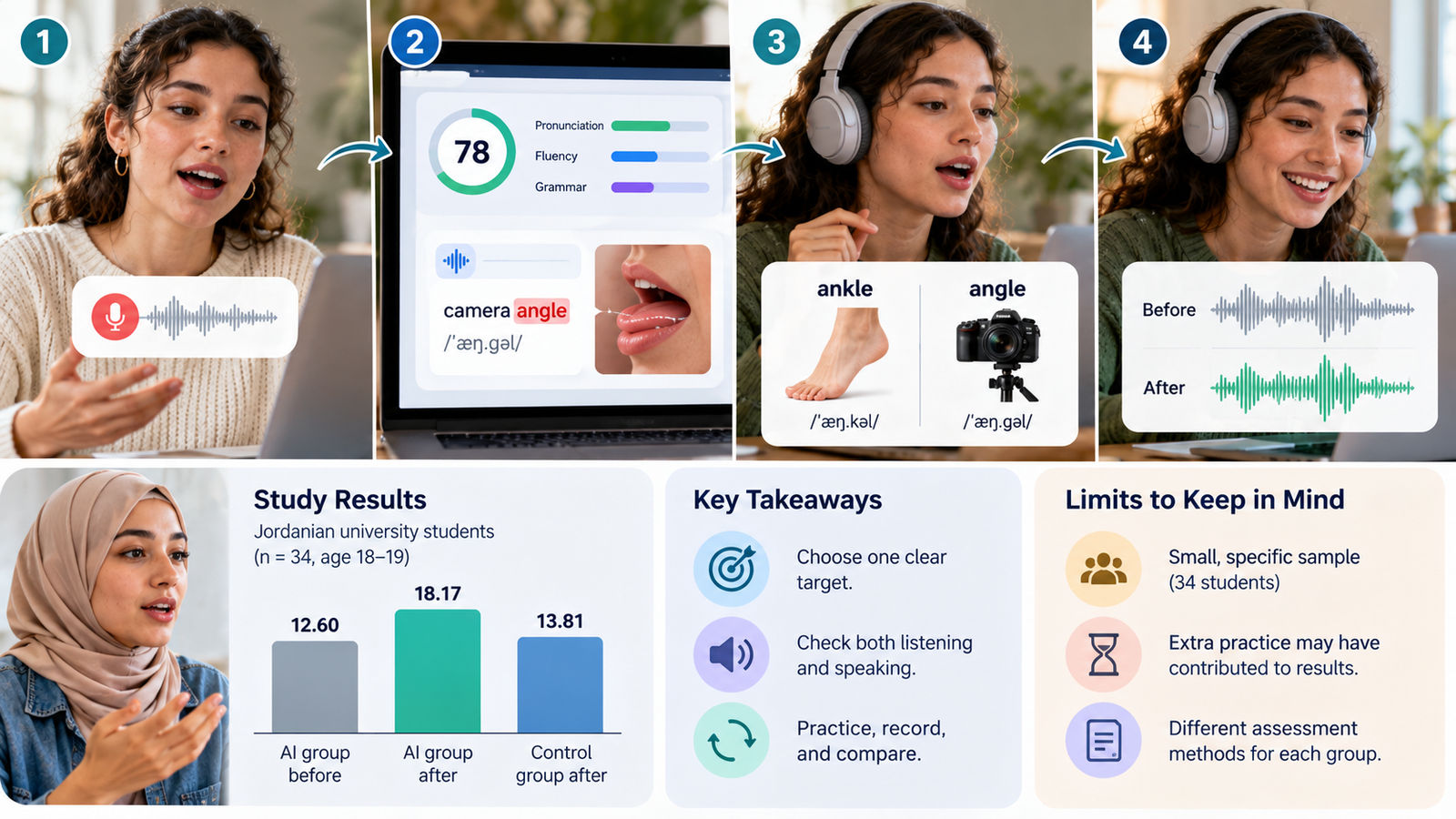
How to Read Research on AI Feedback for English Speaking
When you compare learning methods, ask what changes between the groups. That change is the independent variable. The measured results are the dependent variables.
For example, imagine comparing two pronunciation practice routines. One includes an explanation, several retries and teacher support. The other allows a single attempt. Even if the first group performs better, you still need another comparison to discover which part helped most.
A speaking assessment raises a second question: did everyone take the same test under the same conditions? A strong comparison would use common tasks and scoring rules, preferably with assessors who do not know each learner’s group.
These questions help you judge what a result supports. A higher score can justify further investigation without showing that the same improvement will happen for every learner.
For your own English speaking skills, keep the comparison manageable. Save an early recording, note your practice conditions, and try a fresh task later. This will not create a controlled experiment, but it gives you more useful evidence than your memory alone.
Common Problems with AI Feedback for English Speaking
The comment is too broad to guide your next attempt
“Improve pronunciation” leaves the next step unclear. Look for a word, sound or phrase you can locate in the recording. If the tool does not provide that detail, ask a teacher or listener to help identify one difficult part.
You could turn a broad comment into this question: “Can a listener distinguish ankle from angle when I describe the picture?”
AI feedback for English speaking should lead to an action you understand. If it does not, pause before repeating the entire response.
You try to correct every category at once
A report may discuss pronunciation and intonation alongside vocabulary and grammar. Choose one target for the next recording. Keep the other comments in your notes for another pronunciation practice session.
For instance, you might work on the stress difference between a PERmit and to perMIT. In these common pronunciations, the noun has first-syllable stress and the verb has second-syllable stress. Capital letters here mark the stronger syllable, not extra loudness throughout the word.
Our sentence stress guide offers a related way to explore emphasis across a whole sentence.
The score becomes your only target
Before you record, write what a listener should understand. This gives your English pronunciation practice a purpose you can explain. Perhaps they need to identify an object, follow a sequence or hear which detail you are correcting.
Then compare that goal with the AI pronunciation feedback. A higher number does not tell you everything about whether you communicated the intended message.
Keep this distinction visible during accent training: your practice target needs a clear connection to communication.
How to Practice: Turn One Comment into a Clearer Response
The routine below is an original teaching exercise. It does not reproduce the experiment or claim to be a tested training schedule.
1. Record a short explanation
Describe an everyday decision without reading a prepared script. For example: “Which location would you choose for an outdoor art workshop, and why?”
Save the recording. Before checking automated speaking feedback, listen once and note anything you want to examine. Our guide to self-monitoring and real-time feedback can help you organize those observations.
2. Select one comment you can investigate
Choose a specific point from the report. If automated speaking feedback flags a word, find the moment in your recording. If it mentions unclear emphasis, write down what you wanted the listener to notice.
For English pronunciation, a useful note might read: “I want the final sound in grieve to be distinguishable from the final sound in grief.” Here /v/ and /f/ represent the sounds at the beginning of van and fan.
Use AI feedback for English speaking to narrow your focus before recording again.
3. Listen to a model and rehearse the target
Check a reliable spoken example. Try the target word on its own, then in a phrase. With grief/grieve, you could practice “a feeling of grief” and “time to grieve.” Grief is deep sadness, often after a loss; to grieve means to experience that sadness.
These phrases have different meanings, so use them to explore the sounds before testing yourself. For a harder listening check, ask a partner to identify isolated recordings without seeing the words.
Use AI feedback for English speaking to support this focused rehearsal. Keep your English pronunciation notes specific. Write the word and sound you are working on rather than “my accent is bad.”
4. Record a fresh sentence
Create a sentence that uses the target naturally. To practice the noun and verb stress in permit, try:
Our permit expires tomorrow.
Will they permit an evening workshop?
Ask a listener which syllable sounded strongest. Check a model if you are unsure about the answer. These are original teaching examples, not items from the research.
You can use the sentence recording exercise to keep this pronunciation practice organized.
5. Return to your message
Explain the workshop decision again, using your own words. Include the target only if it fits naturally. Otherwise, choose a different speaking prompt that gives you a reason to use it.
Compare the two recordings. Did the feature you practiced become clearer? Did you still explain your idea fully? AI pronunciation feedback can contribute information here, alongside your listening notes and another person’s response.
6. Check another example later
In a later session, test the same feature in a different word or sentence. For final /f/ and /v/, try proof/prove. Check a model first, then record both and ask a listener to identify them.
This checks a fresh example instead of repeating an already familiar answer. Keep the speaking assessment conditions similar: use the same recording setup and give your listener the same instructions. Your accent training notes can track the target, the attempt and the listener’s response separately.
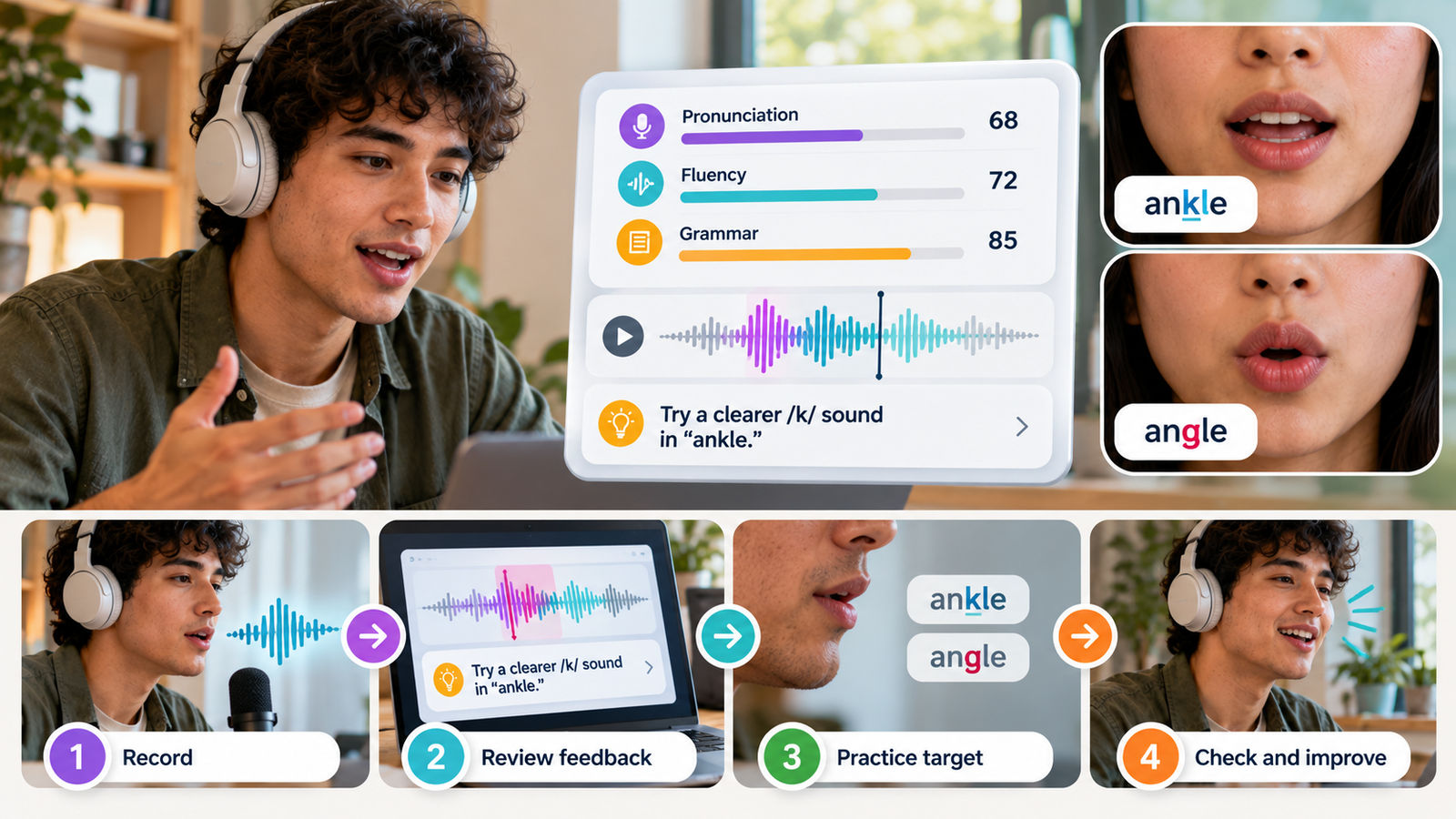
The broader pronunciation feedback loop connects these steps: attempt, review, adjust and check again.
Frequently Asked Questions
Can AI feedback for English speaking replace a teacher?
Use it as one source of information. A teacher can help you interpret a confusing comment, choose an appropriate target and check whether your speech conveys the intended meaning. Seek that help when repeated attempts leave you unsure what to change.
How should I choose between pronunciation and intonation targets?
Start with a difficulty you can identify in a recording. If a word is misunderstood, examine its sounds. If the listener misses which detail matters, examine emphasis. Choose one target and make another recording to investigate it.
Does a higher app score guarantee a better IELTS or TOEFL result?
No. An app score is not an official exam result. Use it to inform practice while preparing for the actual tasks and assessment criteria of your chosen exam.
How can I check whether my English pronunciation is clearer?
Ask a listener what they heard before showing your script. Keep their answer alongside your recording and practice notes. Try a fresh example later so your check extends beyond a familiar sentence.
Reference
Al-husban, N. (2025). The impact of AI-assisted language learning tools on augmenting university EFL students’ speaking skills in Jordan. Journal of Applied Learning and Teaching, 8(1), 116–127. https://doi.org/10.37074/jalt.2025.8.1.13
Get started with the Syranto app today, and see how specific and personalized AI feedback helps your English accent grow!
Shape your accent, we guide the way.
Reading helps you understand. Practice helps you change how you sound.
Start practicing →