Get Android
AI Vowel Pronunciation Training: Can You Separate “Slick” and “Sleek”?
English has some key vowel differences, and AI feedback can help you recognize and train with them. Here's what the research says about vowel training for a more natural English accent.

A sleek jacket looks smooth and stylish. A slick path may be slippery. The words share the same consonants, but one vowel changes the description.
That small difference gives AI vowel pronunciation training a clear task: help you work on two sounds that change a word’s meaning. Before choosing an exercise, it helps to separate two questions. Can you hear the difference? Can you produce it?
Quick Answer
AI vowel pronunciation training uses automated feedback to guide practice with particular vowel sounds. For pairs such as slick and sleek, check both your listening and your spoken recordings. Choose a clear model, inspect the feedback, and test the contrast in another word or sentence. An app score alone cannot show how well a listener understands you.
Why This Matters for English Learners
English vowel pronunciation can change meaning even when the surrounding consonants stay the same. Compare these pairs:
/ɪ/ Vowel | /iː/ Vowel | Meaning Difference |
|---|---|---|
slick | sleek | Slippery; smooth and stylish |
grin | green | A broad smile; a color |
skim | scheme | Read quickly; make a plan |
These are minimal pairs: words that differ by one speech sound. The examples here are teaching materials, not a reproduction of the study’s test items.
You may see the vowels written as /ɪ/, as in slick, and /iː/, as in sleek, in British pronunciation guides. The symbols identify sounds rather than spellings. The mark ː indicates length, but vowel quality also matters: simply holding the same sound longer may leave the contrast unclear.
For accent training, the practical goal is easy to describe: make the intended word recognizable. You can explore further examples in our guide to minimal pair exercises.
What Did the Researchers Test?
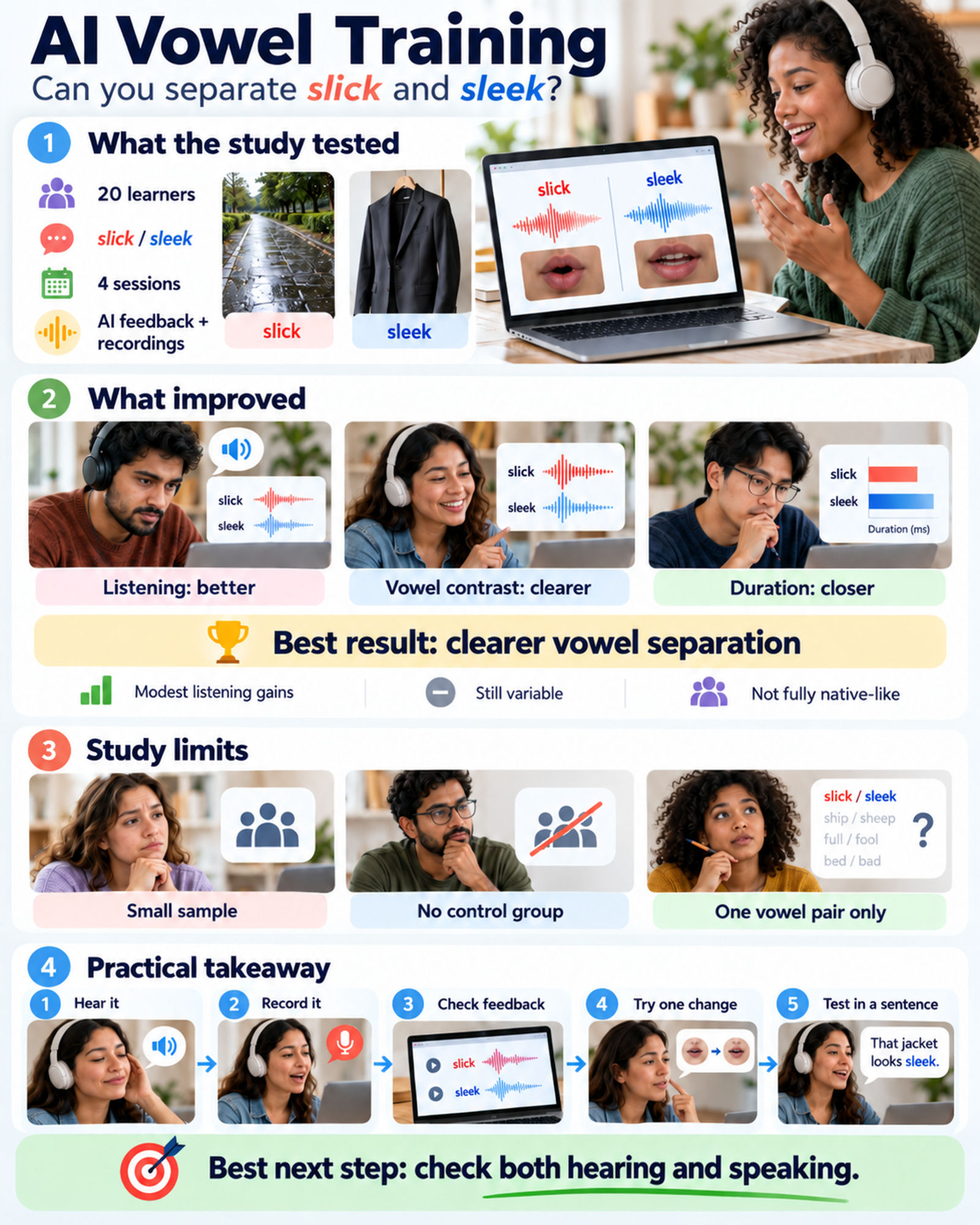
Georgiou’s 2026 study involved 20 female Cypriot Greek university students aged 20–29, averaging 23.85, at upper-B2–C1 English levels. It examined /iː/–/ɪ/ using Speakometer’s models, recording, automated scoring and written feedback.
How Did the Experiment Work?
Test vowel discrimination and production in sentences.
Complete four one-hour production-training sessions across one month; no discrimination exercises were assigned.
Repeat tests and compare results statistically.
There was no untreated learner group. Native-speaker references comprised eight perception participants and ten speakers’ existing production recordings. Outcomes came from listening tests and acoustic analysis, not app scores alone.
What Did the Results Show?
Measure | Reported Result |
|---|---|
Vowel discrimination | Modest, statistically significant improvement |
Acoustic separation | Greater separation between the vowels |
Duration contrast | Shift toward the reference pattern, with substantial variability |
Performance remained different from native references. The author concludes that app-supported practice may help, but this design cannot isolate AI feedback from repetition or model listening.
What Are the Limits?
The small, homogeneous sample and single contrast limit generalization. Timing is inconsistent: the posttest section says one month after intervention, while the limitations state no delayed posttest. Retention therefore remains uncertain. Read the methods and discussion.
Understanding the Measures Behind an App Score
AI vowel pronunciation training can involve several different kinds of information. A listening result, an acoustic measurement and an app score answer different questions.
Vowel discrimination means telling sounds apart. In a listening task, you might hear three examples and decide whether the middle sound matches the first or last. You can make that choice without saying anything yourself.
Vowel production means making the sound. A recording lets someone examine what you actually said. Researchers can measure features called formants, commonly labeled F1 and F2, which help describe vowel quality. They can also measure how long a vowel lasts.
For everyday English pronunciation practice, you do not need to calculate formants. You do need a clear question for your next attempt: “Did I say two distinguishable words?” is something you can investigate with recordings and a listener.
When reviewing AI pronunciation feedback, check what the tool claims to measure. A word-recognition result and a detailed sound analysis provide different information. Ask for an explanation before treating either as a complete assessment of your English pronunciation.
Common Problems in AI Vowel Pronunciation Training
You make one vowel longer but keep the same sound quality
Length is one feature of English vowel sounds. Listen to how the vowel itself sounds as well as how long it lasts. Use the same speaker’s examples initially so you can compare a consistent pair.
If you cannot identify what to change, ask a teacher to demonstrate the contrast and explain the mouth position. Avoid guessing from spelling alone.
You recognize the word because you already know the answer
Looking at grin while listening to your own recording tells you what you intended to say. Hide the word and ask someone else what they heard. This gives your English pronunciation practice a useful outside check.
You can also ask a partner to play model recordings in an unpredictable order. Write down your choices before checking the answers. Keep that listening check separate from your English pronunciation practice.
You keep repeating without a clear adjustment
After several attempts, stop and review the AI pronunciation feedback. Can you name the feature you are trying to change? If the message is vague, return to the model or seek another explanation.
Keep one accent training target visible in your practice notes. Our guide to noticing pronunciation differences introduces a useful way to describe what you hear.
How to Practice: Hear, Record and Check a Vowel Pair
This is an original practice routine for readers. It combines listening and speaking tasks and does not reproduce the experiment above. The steps are suggestions, not a tested training schedule.
1. Choose one pair and a clear model
Start with slick/sleek or grin/green. Listen to both words from a reliable pronunciation source. Keep your attention on the vowel rather than changing the surrounding consonants.
For this round of accent training, write a specific goal: “I want a listener to distinguish these two words.”
2. Check your listening separately
Ask a partner to play the two model words in a mixed order without showing you which one is playing. Choose the word you heard, then check the answer.
Keep a separate note of your listening answers. Vowel discrimination and speaking accuracy should not be combined into one homemade score.
3. Record both words
Say each word at a comfortable pace. If you use AI vowel pronunciation training, choose an activity that covers your target contrast and read its feedback instructions first.
Keep the microphone position and recording space consistent. Save the audio so you have something to compare beyond the latest number on the screen.
4. Choose one adjustment
Review the model and your recording. If the AI pronunciation feedback identifies a specific issue, check that you understand it before repeating the word.
Make another recording after the adjustment. If you still cannot hear the distinction, ask a teacher or experienced listener to help you choose the next step.
5. Put the words in a short sentence
Try the same frame with both words:
That surface looks slick.
That surface looks sleek.
In the first sentence, you describe a surface that looks slippery. In the second, you describe its smooth, stylish appearance. Ask a listener which description they heard before showing your script. These sentences are original teaching examples. For more structured pronunciation practice, use our sentence recording guide.
6. Check a fresh example later
Return to the contrast in a later session and try another pair, such as mill/meal: a place where grain is processed versus food eaten at one sitting. Record what happened rather than assuming that success on one pair applies to every word.
This gives you another observation of your English vowel pronunciation. It is an informal progress check, not proof of lasting improvement or a substitute for a controlled test.
You can organize your notes around the broader pronunciation feedback loop: choose a target, attempt it, review the information, adjust, and check again.
Where Syranto Fits
Syranto’s Vocalize feature offers text-to-speech with British and American voice options. Use it to hear a model of a short sentence you want to practice, then record your own attempt with a recording tool.
Keep the model, your recording and any AI pronunciation feedback as separate sources of information. The study examined Speakometer; it does not establish results for Syranto.
Choose one pair of English vowel sounds for your next session. Decide how you will check both your listening and your spoken contrast before you begin.
Frequently Asked Questions
What is AI vowel pronunciation training?
It is practice focused on vowel sounds with feedback from an automated system. Before using it, check whether the tool identifies individual sound problems, recognizes words, or provides a broader score. Use that information to set an appropriate target.
Are “slick” and “sleek” different only in length?
No. In common British reference pronunciations, the vowels differ in quality as well as duration. Listen to clear examples and compare both features. A stretched version of your first vowel may still sound like the same word.
How can I check English pronunciation without trusting only an app score?
Save your recordings and ask someone to identify the word without seeing the script. Note where misunderstandings occur. Use that information alongside the app’s comments to plan your next attempt.
Should my accent training include listening and speaking?
Give yourself opportunities to check both. A listening task asks whether you can recognize the contrast; a recording task asks whether you can produce it. Keeping separate notes helps you see which part of your pronunciation practice needs attention.
Reference
Georgiou, G. P. (2026). Improving nonnative speech perception and production through an AI-powered application. Humanities and Social Sciences Communications, 13, 891. https://doi.org/10.1057/s41599-026-07186-z
Syranto uses the latest AI feedback technology to keep your pronunciation training on track. Try it today!
Shape your accent, we guide the way.
Reading helps you understand. Practice helps you change how you sound.
Start practicing →