
 Get Android
Popular English Pronunciation Mistakes for German Speakers
Many native German speakers make similar and frequent English pronunciation errors. Let's look at these mistakes and the most effective ways to correct them!
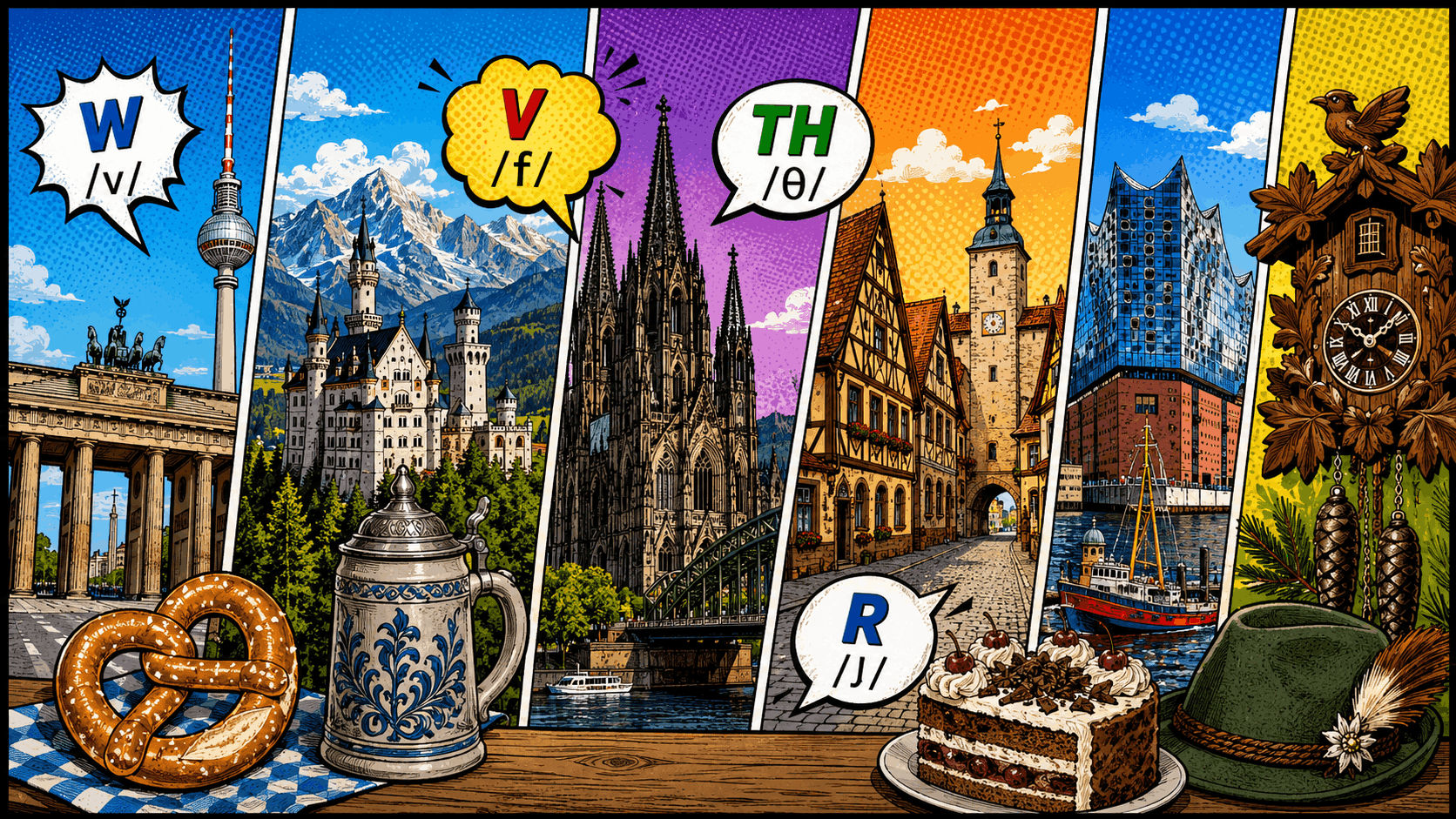
Many German speakers learn English with strong grammar and vocabulary. Still, pronunciation can feel difficult because German and English use different sound rules. Some English sounds do not exist in German. Other sounds look familiar in spelling, but they use a different mouth position or a different sound pattern.
This guide explains the most common English pronunciation mistakes for German speakers, why they happen, and how to practice them. The goal is not to remove your accent. The goal is clear, confident English.
Why English Pronunciation Is Difficult for German Speakers
German and English share many roots, so some words look similar. That can help with vocabulary, but it can also create pronunciation problems. A German speaker may expect English letters to follow German sound rules.
One major difference is final devoicing. In German, voiced consonants like /b/, /d/, and /g/ can become voiceless at the end of a word. This means a German word spelled with final d may sound like it ends in /t/. Research on German phonology describes final devoicing as a regular part of German speech.
English works differently. In English, final voiced sounds can change meaning. Bad and bat are different words. Bag and back are different words. This difference explains many English pronunciation problems for German speakers.
Common English Pronunciation Mistakes for German Speakers
1. /w/ and /v/ Sounds
One of the most common English pronunciation mistakes for German speakers is mixing /w/ and /v/. In German, the letter w is usually pronounced like English /v/. In English, /w/ uses rounded lips, while /v/ uses the top teeth and lower lip.
This can make wine sound like vine, or west sound like vest.
Practice words:
wine / vine
west / vest
wet / vet
worse / verse
Practice sentence:
We went west in very windy weather.
Tip: For /w/, round your lips forward. Do not touch your teeth to your lip. For /v/, touch your top teeth to your lower lip and use your voice.
2. Final Voiced Consonants
German final devoicing can transfer into English. This means final voiced sounds may become voiceless. For example, bad may sound like bat, bag may sound like back, and robe may sound like rope. Studies on German speakers learning English have examined how German final devoicing affects English word pairs such as rod and rot.
Practice words:
bad / bat
bag / back
robe / rope
seed / seat
leave / leaf
Practice sentence:
The seed and the leaf are black and green.
Tip: Keep your voice on through the final consonant. Touch your throat. You should feel vibration at the end of bad, bag, and leave.
3. “Th” Sounds: /θ/ and /ð/
English has two “th” sounds: /θ/ in think and /ð/ in this. German does not use these sounds as native phonemes. German speakers may replace them with /s/, /z/, /t/, or /d/.
This can make think sound like sink, or they sound like day. Research on German learner English identifies fortition of dental fricatives /θ/ and /ð/ as a feature of German-accented English.
Practice words:
think
three
both
this
they
mother
Practice sentence:
I think they both saw three things.
Tip: Put your tongue lightly between your teeth. Push air out for /θ/. Add voice for /ð/.
4. /æ/ and /e/ Vowels
English separates /æ/ and /e/. German does not use the same contrast in the same way. As a result, words like bad and bed, or man and men, may sound too similar.
This vowel contrast matters because it changes meaning.
Practice words:
bad / bed
man / men
sat / set
pan / pen
Practice sentence:
The man sat on the bed with a pen.
Tip: For /æ/, open your mouth more and lower your jaw. For /e/, keep the vowel shorter and less open.
5. English /r/
German has several regional /r/ pronunciations. Many speakers use a back-of-the-mouth or uvular /r/. English /r/ is usually made with the tongue pulled back or curled slightly, without touching the roof of the mouth.
If German /r/ transfers into English, words like red, right, and around may sound less clear to some listeners.
Practice words:
red
right
road
around
very
Practice sentence:
Rachel read the report on the red road sign.
Tip: Pull your tongue back slightly. Keep the sound smooth. Do not make a strong sound in the throat.
6. Word Stress and Reduced Vowels
German and English both use stress, but English uses many weak syllables with schwa /ə/, a relaxed “uh” sound. German speakers may pronounce English vowels too clearly because the spelling suggests a full vowel.
For example:
about sounds like /ə-BOUT/
support sounds like /sə-PORT/
problem sounds like /PROB-ləm/
important sounds like /im-POR-tənt/
This is why English pronunciation for German speakers should include rhythm, not only individual sounds.
Practice sentence:
I need support with this important problem.
Tip: Make the stressed syllable stronger. Make the weak syllables shorter and softer.
Quick Pronunciation Practice for German Speakers
Use this 10-minute routine:
Choose one sound, such as /w/ or /θ/.
Practice five minimal pairs.
Say one short sentence slowly.
Record yourself.
Listen only for the target sound.
Repeat the sentence three times.
Use Syranto to check your speech and track your weak sounds.
Focused pronunciation practice for German speakers works best when you train one pattern at a time.
FAQ
What English sounds are difficult for German speakers?
Common difficult sounds include /w/, /θ/, /ð/, final voiced consonants, /æ/, English /r/, and reduced vowels like schwa /ə/. These sounds are difficult because German and English use different sound rules, even when words look similar.
How can German speakers improve English pronunciation?
Start with the sounds that affect clarity most. Practice /w/ and /v/, “th” sounds, final voiced consonants, vowel contrasts, and English rhythm. Record yourself and compare your speech to a clear English model.
Can I reduce my German accent in English?
Yes. You do not need to remove your accent completely. Focus on the specific English pronunciation mistakes for German speakers that affect understanding, then practice them with short words, sentences, and feedback from Syranto.
The Syranto app will help you target your specific English pronunciation mistakes and offer a plan to make it better!
Shape your accent, we guide the way.
Reading helps you understand. Practice helps you change how you sound.
Start practicing →